

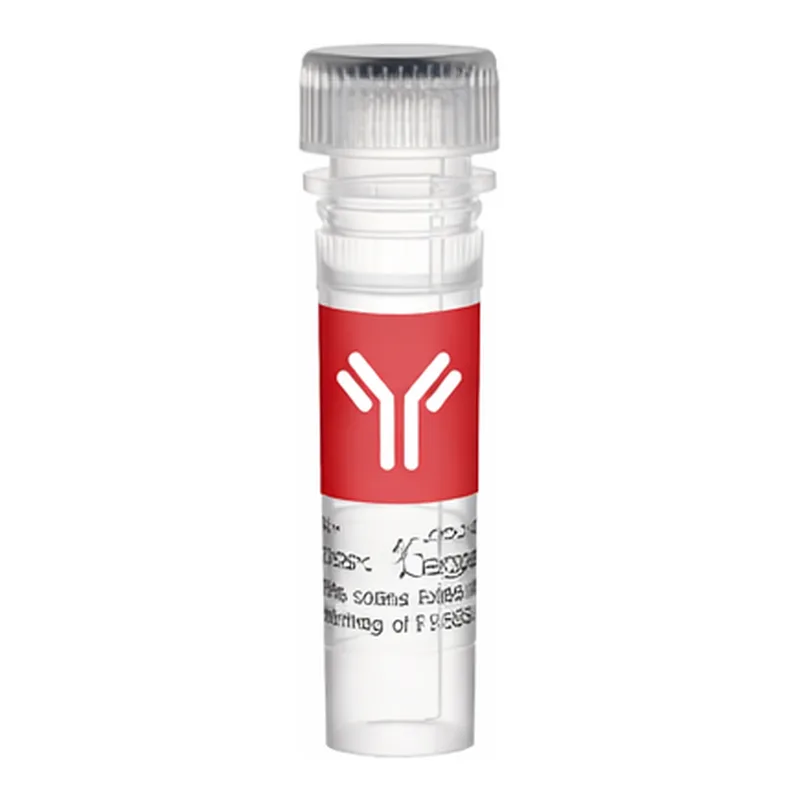
Thermo Fisher Scientific MYOZ1 Polyclonal Antibody
Thermo Fisher Scientific MYOZ1 Polyclonal Antibody는 인간 MYOZ1 단백질을 인식하는 토끼 유래 IgG 항체입니다. IHC(P)에서 1:500–1:1,000 희석으로 사용 가능하며, 항원 친화 크로마토그래피로 정제되었습니다. 근육 단백질 티틴 관련 연구에 적합합니다.
- 판매단위
- pk
카탈로그
1개 옵션 · 카탈로그 번호를 클릭하면 복사됩니다Thermo Fisher Scientific · Thermo Fisher Scientific MYOZ1 Polyclonal Antibody
Applications
Immunohistochemistry (Paraffin) (IHC (P))
- Tested Dilution: 1:500–1:1,000
Product Specifications
| 항목 | 내용 |
|---|---|
| Species Reactivity | Human |
| Host / Isotype | Rabbit / IgG |
| Class | Polyclonal |
| Type | Antibody |
| Immunogen | Recombinant protein corresponding to Human MYOZ1. Recombinant protein control fragment (Product #RP-97178) |
| Conjugate | Unconjugated |
| Form | Liquid |
| Concentration | 0.2 mg/mL |
| Purification | Antigen affinity chromatography |
| Storage buffer | PBS, pH 7.2, with 40% glycerol |
| Contains | 0.02% sodium azide |
| Storage conditions | Store at 4°C short term. For long term storage, store at -20°C, avoiding freeze/thaw cycles. |
| Shipping conditions | Wet ice |
| RRID | AB_2644394 |
Product Specific Information
- Immunogen sequence:
QHHLGSGSGA GGTGGPAGQA GRGGAAGTAG VGETGSGDQA GGEGKHITVF KTYISPWERA MGVDPQQKME LGIDLLA - Highest antigen sequence identity to orthologs:
Mouse – 81%, Rat – 81%
Target Information
Sarcomere assembly is regulated by the muscle protein titin. Titin is a giant elastic protein with kinase activity that extends half the length of a sarcomere. It serves as a scaffold to which myofibrils and other muscle-related proteins are attached.
This gene encodes a protein found in striated and cardiac muscle that binds to the titin Z1-Z2 domains and is a substrate of titin kinase, interactions thought to be critical to sarcomere assembly.
Mutations in this gene are associated with limb-girdle muscular dystrophy type 2G.
For Research Use Only. Not for use in diagnostic procedures. Not for resale without express authorization.
Thermo Fisher Scientific 상품 둘러보기
전체보기
문의
0개 · 배송·재고 문의는 실시간 상담이 빠릅니다아직 등록된 문의가 없어요.