

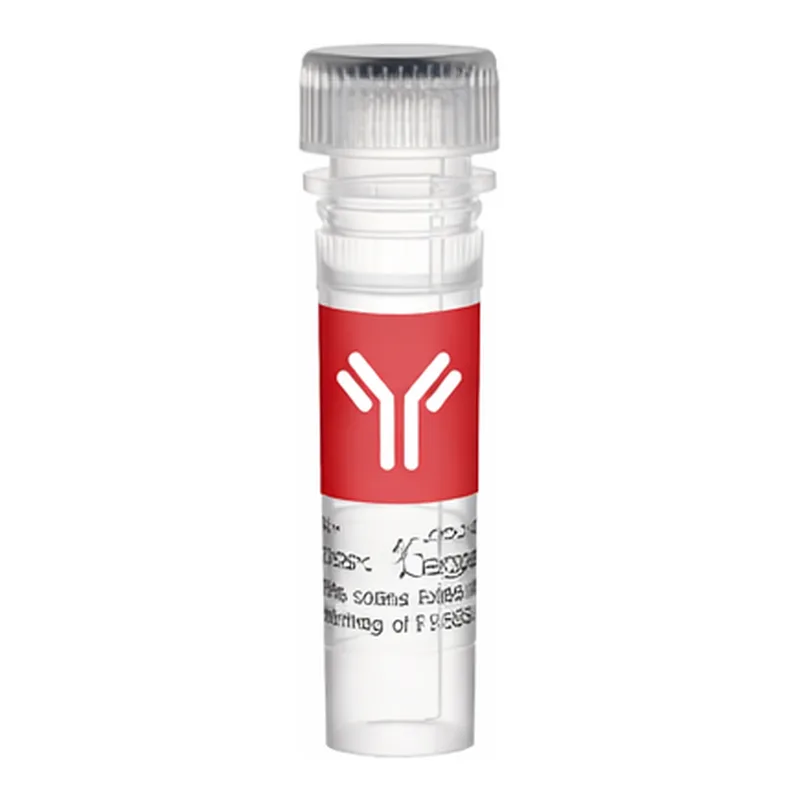
Thermo Fisher Scientific p53 Recombinant Rabbit Monoclonal Antibody (ZR153), RAbMono
Recombinant rabbit monoclonal antibody recognizing both wild-type and mutant human p53 protein. Optimized for IHC (paraffin) applications. Useful for detecting tumor suppressor p53 expression in various carcinomas. Supplied as liquid, 200 µg/mL, Protei...
- 판매단위
- pk
카탈로그
2개 옵션 · 카탈로그 번호를 클릭하면 복사됩니다Thermo Fisher Scientific · Thermo Fisher Scientific p53 Recombinant Rabbit Monoclonal Antibody (ZR153), RAbMono
Applications and Tested Dilution
| Application | Tested Dilution |
|---|---|
| Immunohistochemistry (Paraffin) (IHC (P)) | 1:100–1:200 |
Product Specifications
| Specification | Description |
|---|---|
| Species Reactivity | Human |
| Host / Isotype | Rabbit / IgG |
| Expression System | CHO cells |
| Class | Recombinant Monoclonal |
| Type | Antibody |
| Clone | ZR153 |
| Immunogen | Recombinant human wild type p53 protein |
| Conjugate | Unconjugated |
| Form | Liquid |
| Concentration | 200 µg/mL |
| Purification | Protein A |
| Storage Buffer | Tris with NP-40, BSA |
| Contains | <0.1% sodium azide |
| Storage Conditions | 4°C |
| Shipping Conditions | Wet ice |
Product Specific Information
A recommended positive control tissue for this product is epithelial carcinoma, although other positive controls may also be used.
This antibody is intended for laboratory professional use in detecting the corresponding protein in formalin-fixed, paraffin-embedded tissue for manual qualitative immunohistochemistry (IHC) testing. It is used after the primary diagnosis of tumor has been made by conventional histopathology.
This antibody recognizes a 53 kDa protein identified as the p53 suppressor gene product. It reacts with both mutant and wild-type forms of p53. The p53 protein is a tumor suppressor expressed in various tissues and involved in regulating cell growth, replication, and apoptosis. It binds to MDM2, SV40 T antigen, and human papilloma virus E6 protein. Positive nuclear staining with p53 antibody has been reported as a negative prognostic factor in several carcinomas, including breast, lung, colorectal, and urothelial carcinoma. It is also useful for differentiating uterine serous carcinoma from endometrioid carcinoma and detecting intratubular germ cell neoplasia. Mutations involving p53 are found in many malignant tumors such as breast, ovarian, bladder, colon, lung, and melanoma.
For optimal results, use on formalin-fixed and paraffin-embedded sections with heat-induced or enzymatic epitope retrieval. IHC staining enables visualization of antigens through sequential application of primary antibody, secondary antibody, enzyme complex, and chromogenic substrate. The resulting chromogenic reaction is observed under a light microscope to assist in differential diagnosis.
A positive tissue control must accompany every staining procedure. This control should contain both positive and negative staining components. External positive control materials should be fresh, well-characterized specimens processed in the same manner as patient samples. Weak positive control tissues are recommended for detecting subtle changes in antibody sensitivity or reagent degradation. Negative control tissues, internal or external, verify the absence of non-specific staining.
Target Information
The tumor suppressor protein p53 is a sequence-specific transcription factor activated by cellular stress. It mediates cell cycle arrest or apoptosis in response to DNA damage or nucleotide starvation. p53 activation leads to transcription of genes such as p21waf1, involved in cell cycle arrest at G1 or G2/M. Structurally, p53 includes an N-terminal transactivation domain, a central DNA-binding domain, an oligomerization domain, and a C-terminal regulatory domain.
Phosphorylation at Ser15 is critical for activation and stabilization, while phosphorylation at Ser392 is associated with tumor formation. p53 plays a key role in preventing proliferation of damaged cells and acts as an anticancer factor. It is also linked to aging, oxidative stress, and cognitive function. Normally expressed at low levels, p53 is upregulated in transformed cells, contributing to malignancy. Mutations in p53 lead to loss of DNA-binding and tumor suppressor activity. Alterations in the TP53 gene occur in many human cancers and as germline mutations in cancer-prone families such as Li-Fraumeni syndrome.
For Research Use Only. Not for use in diagnostic procedures. Not for resale without express authorization.
Thermo Fisher Scientific 상품 둘러보기
전체보기
문의
0개 · 배송·재고 문의는 실시간 상담이 빠릅니다아직 등록된 문의가 없어요.