

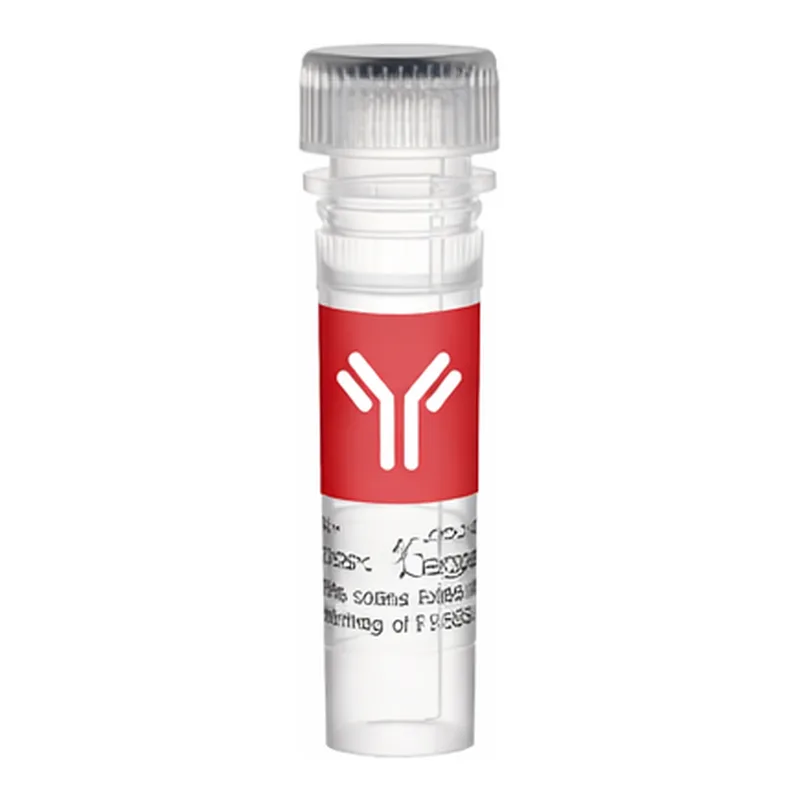
Thermo Fisher Scientific Actin-like 7A Polyclonal Antibody
Actin-like 7A 단백질을 인식하는 Thermo Fisher Scientific의 Rabbit Polyclonal Antibody. 인간 시료에 반응하며, IHC(P)에서 1:1,000~1:2,500 희석으로 사용 가능. 항원 친화 크로마토그래피로 정제된 액상 항체로 연구용에 적합.
- 판매단위
- pk
카탈로그
1개 옵션 · 카탈로그 번호를 클릭하면 복사됩니다Thermo Fisher Scientific · Thermo Fisher Scientific Actin-like 7A Polyclonal Antibody
Applications
Immunohistochemistry (Paraffin) (IHC (P))
- Tested Dilution: 1:1,000–1:2,500
Product Specifications
| 항목 | 내용 |
|---|---|
| Species Reactivity | Human |
| Host / Isotype | Rabbit / IgG |
| Class | Polyclonal |
| Type | Antibody |
| Immunogen | Recombinant protein corresponding to Human Actin-like 7A. Recombinant protein control fragment (Product #RP-93079). |
| Conjugate | Unconjugated |
| Form | Liquid |
| Concentration | 0.1 mg/mL |
| Purification | Antigen affinity chromatography |
| Storage buffer | PBS, pH 7.2, with 40% glycerol |
| Contains | 0.02% sodium azide |
| Storage conditions | Store at 4°C short term. For long term storage, store at -20°C, avoiding freeze/thaw cycles. |
| Shipping conditions | Wet ice |
| RRID | AB_2637637 |
Product Specific Information
Immunogen sequence:
MWAPPAAIMG DGPTKKVGNQ APLQTQALQT ASLRDGPAKR AVWVRHTSSE PQEPTESKAA KERPKQEVTK AVVVDLGTGY CKCGFAGLPR PTHKISTTVG K
Antigen sequence identity:
- Mouse: 70%
- Rat: 71%
Target Information
The protein encoded by this gene is a member of a family of actin-related proteins (ARPs) which share significant amino acid sequence identity to conventional actins. Both actins and ARPs have an actin fold, which is an ATP-binding cleft, as a common feature. The ARPs are involved in diverse cellular processes, including vesicular transport, spindle orientation, nuclear migration, and chromatin remodeling.
This gene (ACTL7A), and related gene, ACTL7B, are intronless and located approximately 4 kb apart in a head-to-head orientation within the familial dysautonomia candidate region on 9q31. Based on mutational analysis, ACTL7A is unlikely to be involved in the pathogenesis of dysautonomia. The ACTL7A gene is expressed in a wide variety of adult tissues, though its exact function is not known.
For Research Use Only. Not for use in diagnostic procedures. Not for resale without express authorization.
제품 이미지
Thermo Fisher Scientific 상품 둘러보기
전체보기
문의
0개 · 배송·재고 문의는 실시간 상담이 빠릅니다아직 등록된 문의가 없어요.