

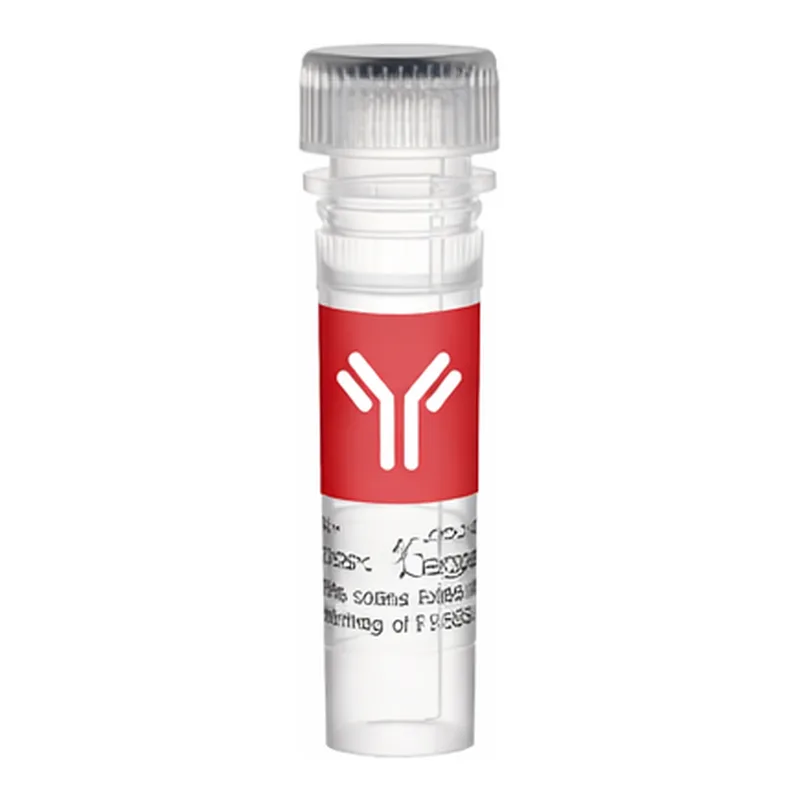
Thermo Fisher Scientific CRISP3 Polyclonal Antibody
CRISP3 단백질을 인식하는 Thermo Fisher Scientific의 토끼 폴리클로날 항체. Western blot과 면역세포염색에 적합하며, 인간, 마우스, 영장류 시료에 반응. 1 mg/mL 농도의 액상 형태로 제공되며, -20°C에서 보관.
- 카탈로그번호
- PA5100453
- 판매단위
- pk
카탈로그
1개 옵션 · 카탈로그 번호를 클릭하면 복사됩니다Thermo Fisher Scientific · Thermo Fisher Scientific CRISP3 Polyclonal Antibody
Applications and Tested Dilution
| Application | Tested Dilution |
|---|---|
| Western Blot (WB) | 1:500–1:2,000 |
| Immunocytochemistry (ICC/IF) | 1:100–1:500 |
Product Specifications
| 항목 | 내용 |
|---|---|
| Species Reactivity | Human, Mouse, Non-human primate |
| Host/Isotype | Rabbit / IgG |
| Class | Polyclonal |
| Type | Antibody |
| Immunogen | A synthesized peptide derived from human CRISP3 (Accession P54108), corresponding to amino acid residues L61–Q111 |
| Conjugate | Unconjugated |
| Form | Liquid |
| Concentration | 1 mg/mL |
| Purification | Affinity chromatography |
| Storage buffer | PBS, pH 7.4, with 50% glycerol |
| Contains | 0.02% sodium azide |
| Storage conditions | -20°C |
| Shipping conditions | Wet ice |
| RRID | AB_2849963 |
Product Specific Information
Antibody detects endogenous levels of total CRISP3.
Target Information
Cysteine-rich secretory protein 3 (CRISP-3; also known as SGP28) is a glycoprotein belonging to the cysteine-rich secretory protein (CRISP) family, originally discovered in human neutrophilic granulocytes.
CRISP-3 is widely distributed in exocrine glands (salivary glands, pancreas, prostate), eosinophilic granulocytes, and to a lower extent in epididymis, ovary, thymus, and colon.
Its presence in neutrophils, eosinophils, and exocrine secretions suggests a role in innate host defense.
This antibody was raised against a recombinant C-terminally truncated form of CRISP-3 and recognizes both N-glycosylated and non-glycosylated forms of the mature protein.
For Research Use Only. Not for use in diagnostic procedures. Not for resale without express authorization.
Thermo Fisher Scientific 상품 둘러보기
전체보기
문의
0개 · 배송·재고 문의는 실시간 상담이 빠릅니다아직 등록된 문의가 없어요.