

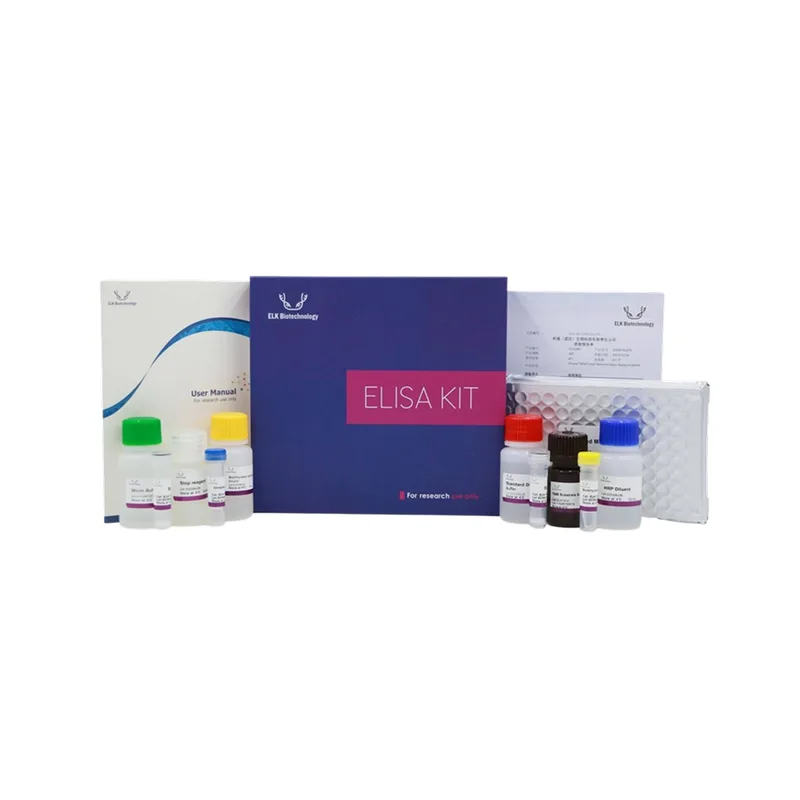
ELK Biotechnology TNNT3 rabbit pAb
TNNT3 단백질을 인식하는 토끼 폴리클로날 항체로, WB 및 ELISA에 적합합니다. 사람, 쥐, 생쥐 시료에 반응하며, 근육 수축 관련 트로포닌 복합체 연구에 활용됩니다. 고순도 IgG 형태로 -20°C에서 1년 보관 가능합니다.
- 판매단위
- pk
카탈로그
2개 옵션 · 카탈로그 번호를 클릭하면 복사됩니다ELK Biotechnology · ELK Biotechnology TNNT3 rabbit pAb
제품명
TNNT3 rabbit pAb
제품 설명
TNNT3 단백질에 특이적으로 결합하는 토끼 폴리클로날 항체입니다. 근육 수축 과정에서 중요한 역할을 하는 트로포닌 복합체 연구에 유용합니다.
제품 정보
| 항목 | 내용 |
|---|---|
| Applications | WB; ELISA |
| Recommended Dilutions | WB 1:500–2000, ELISA 1:5000–20000 |
| Immunogen | Synthesized peptide derived from part region of human protein |
| Host | Rabbit |
| Storage | -20°C / 1 year |
| Clonality | Polyclonal |
| Isotype | IgG |
| Concentration | 1 mg/ml |
| Observed Band | 29 kD |
| Gene ID (Human) | 7140 |
| Human Swiss-Prot No. | P45378 |
| Cellular Localization | Cytosol, troponin complex |
| Species Reactivity | Human, Rat, Mouse |
Background
The binding of Ca(2+) to the trimeric troponin complex initiates the process of muscle contraction. Increased Ca(2+) concentrations produce a conformational change in the troponin complex that is transmitted to tropomyosin dimers situated along actin filaments. The altered conformation permits increased interaction between a myosin head and an actin filament which, ultimately, produces a muscle contraction.
The troponin complex has protein subunits C, I, and T. Subunit C binds Ca(2+) and subunit I binds to actin and inhibits actin-myosin interaction. Subunit T binds the troponin complex to the tropomyosin complex and is also required for Ca(2+)-mediated activation of actomyosin ATPase activity.
There are 3 different troponin T genes that encode tissue-specific isoforms of subunit T for fast skeletal-, slow skeletal-, and cardiac-muscle. This gene encodes fast skeletal troponin T protein.
ELK Biotechnology 상품 둘러보기
전체보기
문의
0개 · 배송·재고 문의는 실시간 상담이 빠릅니다아직 등록된 문의가 없어요.