

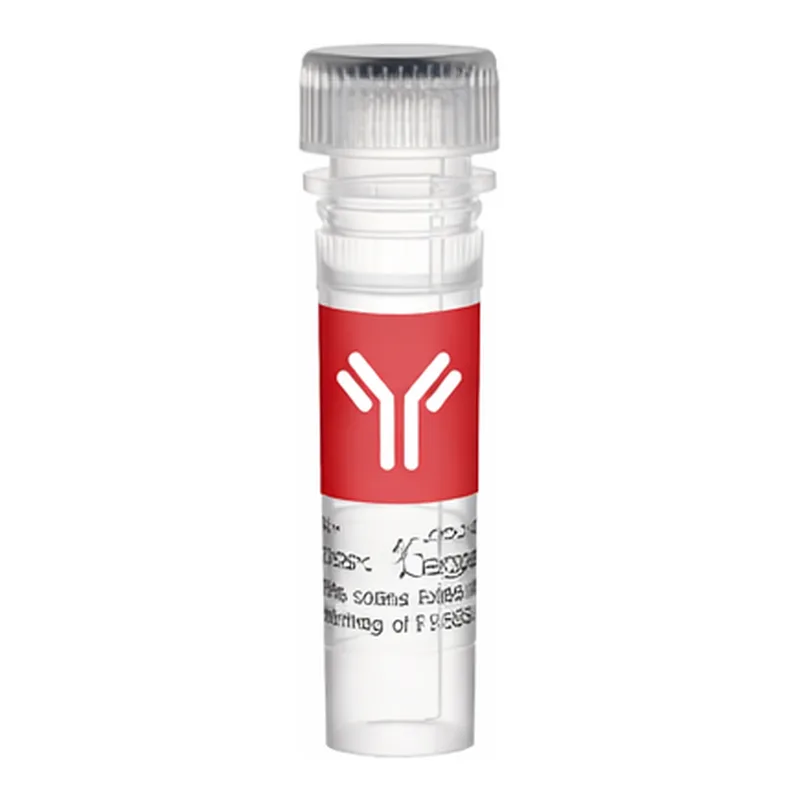
Thermo Fisher Scientific Phospho-EGFR (Ser695) Polyclonal Antibody
EGFR 단백질의 Ser695 인산화 형태를 특이적으로 검출하는 Rabbit Polyclonal Antibody. Western blot, IHC, ICC/IF에 사용 가능. 인간, 생쥐, 랫트 반응성. 고순도 정제 및 안정적 PBS/glycerol buffer 제공.
- 판매단위
- pk
카탈로그
1개 옵션 · 카탈로그 번호를 클릭하면 복사됩니다Thermo Fisher Scientific · Thermo Fisher Scientific Phospho-EGFR (Ser695) Polyclonal Antibody
Thermo Fisher Scientific Phospho-EGFR (Ser695) Polyclonal Antibody
Applications and Tested Dilutions
| Application | Tested Dilution |
|---|---|
| Western Blot (WB) | 1:500–1:2,000 |
| Immunohistochemistry (Paraffin) (IHC (P)) | 1:50–1:200 |
| Immunocytochemistry (ICC/IF) | 1:100–1:500 |
Product Specifications
| Specification | Description |
|---|---|
| Species Reactivity | Mouse, Rat, Human |
| Host / Isotype | Rabbit / IgG |
| Class | Polyclonal |
| Type | Antibody |
| Immunogen | A synthesized peptide derived from human EGFR (Accession P00533), corresponding to amino acid residues around phosphorylated Ser695 |
| Conjugate | Unconjugated |
| Form | Liquid |
| Concentration | 1 mg/mL |
| Purification | Sequential chromatography |
| Storage Buffer | PBS, pH 7.4, with 50% glycerol |
| Contains | 0.02% sodium azide |
| Storage Conditions | -20°C |
| Shipping Conditions | Wet ice |
| RRID | AB_2816198 |
Product Specific Information
This antibody detects endogenous levels of EGFR only when phosphorylated at Serine 695.
Target Information
EGFR (epidermal growth factor receptor) is a receptor tyrosine kinase that mediates signaling in response to various growth factors. Overexpression of EGFR has been associated with multiple cancer types and is a target for biological and small molecule therapeutics.
The EGFR gene is located on chromosome 7 in humans and belongs to the HER/ERbB family of proteins, which includes ERbB2, ERbB3, and ERbB4.
EGFR functions as a transmembrane receptor; ligand binding (e.g., EGF, TGF-α) induces dimerization and autophosphorylation of tyrosine residues in its cytoplasmic domain.
Overexpression is observed in tumors of the head and neck, brain, bladder, stomach, breast, lung, endometrium, cervix, vulva, ovary, esophagus, and squamous cell carcinoma.
Usage Notice
For Research Use Only. Not for use in diagnostic procedures. Not for resale without express authorization.
제품 이미지
(이미지 없음)
Thermo Fisher Scientific 상품 둘러보기
전체보기
문의
0개 · 배송·재고 문의는 실시간 상담이 빠릅니다아직 등록된 문의가 없어요.