

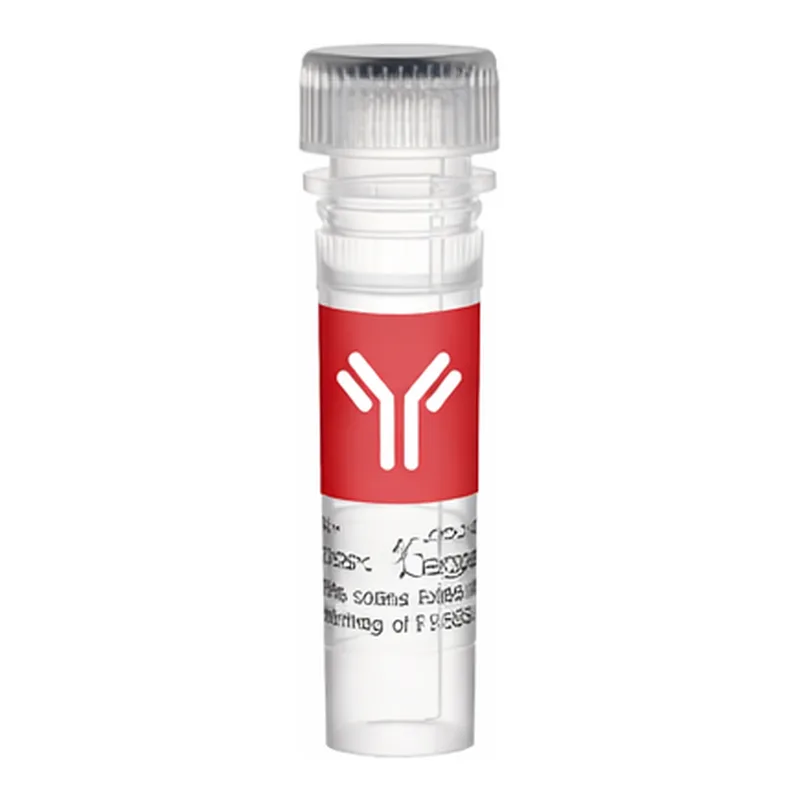
Thermo Fisher Scientific ORP9 Polyclonal Antibody
Thermo Fisher Scientific의 ORP9 Polyclonal Antibody는 인간 ORP9 단백질을 인식하는 토끼 유래 폴리클로날 항체로, Western blot과 IHC에 적합합니다. 합성 펩타이드 면역원으로 제작되었으며, 0.5 mg/mL 농도의 액상 형태로 제공됩니다. 연구용으로만 사용 가능합니다.
- 판매단위
- pk
카탈로그
1개 옵션 · 카탈로그 번호를 클릭하면 복사됩니다Thermo Fisher Scientific · Thermo Fisher Scientific ORP9 Polyclonal Antibody
Applications
| Application | Tested Dilution |
|---|---|
| Western Blot (WB) | 0.2–1 µg/mL |
| Immunohistochemistry (IHC) | 5 µg/mL |
Product Specifications
| 항목 | 내용 |
|---|---|
| Species Reactivity | Human |
| Host / Isotype | Rabbit / IgG |
| Class | Polyclonal |
| Type | Antibody |
| Immunogen | Synthetic peptide directed towards the N-terminal of human OSBPL9 (aa 251–300) |
| Conjugate | Unconjugated |
| Form | Liquid |
| Concentration | 0.5 mg/mL |
| Purification | Affinity Chromatography |
| Storage Buffer | PBS with 2% sucrose |
| Contains | 0.09% sodium azide |
| Storage Conditions | -20°C, Avoid Freeze/Thaw Cycles |
| Shipping Conditions | Wet ice |
| RRID | AB_2605890 |
Product Specific Information
Peptide sequence:
HQTPTPNSTG SGHSPPSSSL TSPSHVNLSP NTVPEFSYSS SEDEFYDADE
Sequence homology:
Cow: 100%
Dog: 100%
Guinea Pig: 100%
Horse: 100%
Human: 100%
Mouse: 93%
Rabbit: 100%
Rat: 100%
Zebrafish: 92%
Target Information
This gene encodes a member of a subfamily of LIM domain proteins characterized by an N-terminal proline-rich region and three C-terminal LIM domains. The encoded protein localizes to the cell periphery in focal adhesions and may be involved in cell-cell adhesion and motility. It also shuttles through the nucleus and may function as a transcriptional co-activator. This gene is located at the junction of disease-related chromosomal translocations that can produce chimeric proteins promoting tumor growth. Alternate splicing results in multiple transcript variants.
For Research Use Only. Not for use in diagnostic procedures. Not for resale without express authorization.
Thermo Fisher Scientific 상품 둘러보기
전체보기
문의
0개 · 배송·재고 문의는 실시간 상담이 빠릅니다아직 등록된 문의가 없어요.