

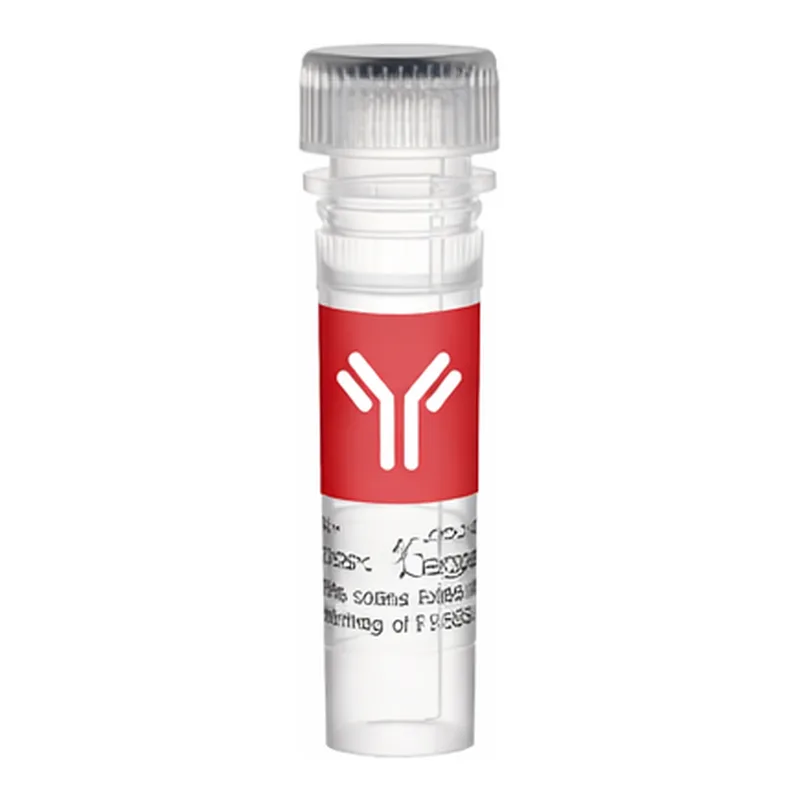
Thermo Fisher Scientific PABPN1 Polyclonal Antibody
PABPN1 단백질을 인식하는 Thermo Fisher Scientific의 폴리클로날 항체로, Western blot 및 IHC(P) 검증 완료. 인간 및 마우스 반응성. 항원 친화 크로마토그래피 정제, 액상 형태, 장기 보관 시 -20°C 권장. 연구용 전용 제품.
- 카탈로그번호
- PA551430
- 판매단위
- pk
카탈로그
1개 옵션 · 카탈로그 번호를 클릭하면 복사됩니다Thermo Fisher Scientific · Thermo Fisher Scientific PABPN1 Polyclonal Antibody
Applications and Tested Dilution
| Application | Tested Dilution | Publications |
|---|---|---|
| Western Blot (WB) | 0.04–0.4 µg/mL | View 1 publication |
| Immunohistochemistry (Paraffin) (IHC (P)) | 1:50–1:200 | — |
Product Specifications
| 항목 | 내용 |
|---|---|
| Species Reactivity | Human, Mouse |
| Published Species | Human |
| Host / Isotype | Rabbit / IgG |
| Class | Polyclonal |
| Type | Antibody |
| Immunogen | Recombinant protein corresponding to Human Bcl-W. Recombinant protein control fragment (Product #RP-88906) |
| Conjugate | Unconjugated |
| Form | Liquid |
| Concentration | 0.1 mg/mL |
| Purification | Antigen affinity chromatography |
| Storage Buffer | PBS, pH 7.2, with 40% glycerol |
| Contains | 0.02% sodium azide |
| Storage Conditions | Store at 4°C short term. For long term storage, store at -20°C, avoiding freeze/thaw cycles. |
| Shipping Conditions | Wet ice |
| RRID | AB_2638516 |
Product Specific Information
Immunogen sequence:
MSIEEKMEAD ARSIYVGNVD YGATAEELEA HFHGCGSVNR VTILCDKFSG HPKGFAYIEF SDKESVRTSL ALDESLFRGR QIKVIPKRTN RPGISTTDRG FPRARYRART TNYNSSRSRF YSGFNSRPRG RVYRGRARAT SWY
Antigen sequence identity:
- Mouse: 98%
- Rat: 99%
Target Information
This gene encodes an abundant nuclear protein that binds with high affinity to nascent poly(A) tails. The protein is required for progressive and efficient polymerization of poly(A) tails at the 3′ ends of eukaryotic transcripts and controls the size of the poly(A) tail to about 250 nt.
At steady-state, this protein is localized in the nucleus, while a different poly(A) binding protein is localized in the cytoplasm.
Expansion of the GCG trinucleotide repeat from 6 to 8–13 copies in this gene leads to autosomal dominant oculopharyngeal muscular dystrophy (OPMD).
Related pseudogenes have been identified on chromosomes 19 and X. Read-through transcription also exists between this gene and the neighboring upstream BCL2-like 2 (BCL2L2) gene.
For Research Use Only. Not for use in diagnostic procedures. Not for resale without express authorization.
Thermo Fisher Scientific 상품 둘러보기
전체보기
문의
0개 · 배송·재고 문의는 실시간 상담이 빠릅니다아직 등록된 문의가 없어요.