

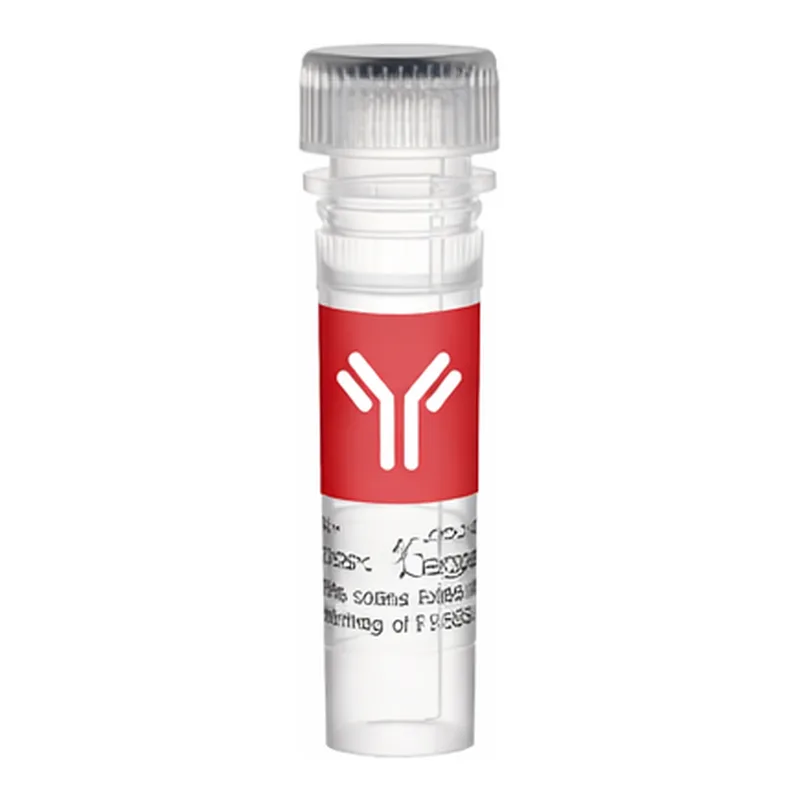
Thermo Fisher Scientific SHANK2 Monoclonal Antibody (S23b-6)
SHANK2 단백질을 표적하는 Thermo Fisher Scientific의 Mouse Monoclonal Antibody (Clone N23b/6). Western blot, IHC, ICC, IP 등 다양한 응용 가능. 약 160 kDa 단백질 검출, Shank1/3 비교반응 없음. 액상형, 1 mg/mL 농도, -20°C 보관.
- 카탈로그번호
- MA527634
- 판매단위
- pk
카탈로그
1개 옵션 · 카탈로그 번호를 클릭하면 복사됩니다Thermo Fisher Scientific · Thermo Fisher Scientific SHANK2 Monoclonal Antibody (S23b-6)
Applications and Tested Dilution
| Application | Tested Dilution |
|---|---|
| Western Blot (WB) | 1:1,000 |
| Immunohistochemistry (PFA fixed) (IHC (PFA)) | 1:100 |
| Immunocytochemistry (ICC/IF) | 1:100 |
| Immunoprecipitation (IP) | Assay-dependent |
| Antibody Microarray (AM) | Assay-dependent |
Product Specifications
| Specification | Description |
|---|---|
| Host / Isotype | Mouse / IgG1 |
| Class | Monoclonal |
| Type | Antibody |
| Clone | N23b/6 |
| Immunogen | Fusion protein amino acids 84–309 (SH3/PDZ domains) of rat Shank2 (SH3 and multiple ankyrin repeat domains protein 2) |
| Conjugate | Unconjugated |
| Form | Liquid |
| Concentration | 1 mg/mL |
| Storage Conditions | -20°C |
| Shipping Conditions | Wet ice |
| RRID | AB_2735361 |
Product Specific Information
- 1 µg/mL of MA5-27634 was sufficient for detection of Shank2 in 10 µg of rat brain lysate by colorimetric immunoblot analysis using Goat anti-mouse IgG:HRP as the secondary antibody.
- Detects approximately 160 kDa.
- No cross-reactivity against Shank1 or Shank3.
- Weak mouse detection.
Target Information
This gene encodes a protein that is a member of the Shank family of synaptic proteins that may function as molecular scaffolds in the postsynaptic density of excitatory synapses. Shank proteins contain multiple domains for protein-protein interaction, including ankyrin repeats and an SH3 domain. This particular family member contains a PDZ domain, a consensus sequence for cortactin SH3 domain-binding peptides, and a sterile alpha motif.
Alternative splicing demonstrated in Shank genes has been suggested as a mechanism for regulating the molecular structure of Shank and the spectrum of Shank-interacting proteins in the postsynaptic densities of the adult and developing brain.
Alterations in the encoded protein may be associated with susceptibility to autism spectrum disorder. Alternative splicing results in multiple transcript variants.
For Research Use Only. Not for use in diagnostic procedures. Not for resale without express authorization.
Thermo Fisher Scientific 상품 둘러보기
전체보기
문의
0개 · 배송·재고 문의는 실시간 상담이 빠릅니다아직 등록된 문의가 없어요.