

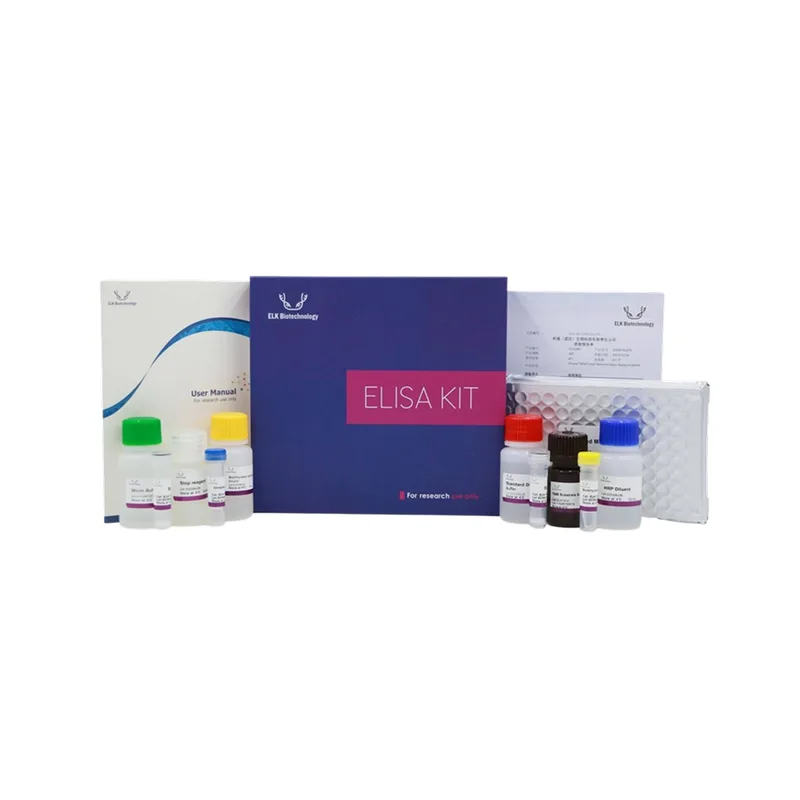
ELK Biotechnology CBLB rabbit pAb
CBLB 단백질을 인식하는 토끼 폴리클로날 항체로, WB 및 ELISA에 적합합니다. 인간, 생쥐, 랫트 시료에 반응하며 고순도 IgG 형태로 제공됩니다. 세포 내 단백질 유비퀴틴화 연구에 활용 가능합니다.
- 판매단위
- pk
카탈로그
2개 옵션 · 카탈로그 번호를 클릭하면 복사됩니다ELK Biotechnology · ELK Biotechnology CBLB rabbit pAb
ELK Biotechnology CBLB rabbit pAb
제품 개요
CBLB 단백질을 검출하기 위한 토끼 유래 폴리클로날 항체입니다. 주로 Western Blot(WB) 및 ELISA 실험에 사용되며, 세포 내 단백질 유비퀴틴화 및 신호전달 경로 연구에 유용합니다.
제품 정보
| 항목 | 내용 |
|---|---|
| Product name | CBLB rabbit pAb |
| Applications | WB; ELISA |
| Recommended Dilutions | WB 1:500–2000, ELISA 1:5000–20000 |
| Immunogen | Synthesized peptide derived from part region of human protein |
| Species Reactivity | Human; Rat; Mouse |
| Clonality | Polyclonal |
| Isotype | IgG |
| Concentration | 1 mg/ml |
| Observed Band | 108 kD |
| Gene ID (Human) | 868 |
| Human Swiss-Prot No | Q13191 |
| Cellular Localization | Cytoplasm. Upon EGF stimulation, associates with endocytic vesicles. |
| Storage | −20°C / 1 year |
Background
The N-terminus of CBLB is composed of a phosphotyrosine binding (PTB) domain, linker region, and RING-type zinc finger. The PTB domain includes a four-helix bundle, calcium-binding EF hand, and divergent SH2 domain.
The RING-type zinc finger mediates binding to E2 ubiquitin-conjugating enzymes, while the UBA domain interacts with poly-ubiquitinated proteins.
CBLB acts as an E3 ubiquitin-protein ligase, transferring ubiquitin to substrates and promoting their proteasomal degradation. It negatively regulates TCR, BCR, and FCER1 signaling pathways. In naive T-cells, it inhibits VAV1 activation and requires CD28 costimulation for proliferation and IL-2 production.
In activated T-cells, CBLB inhibits PLCG1 activation and calcium mobilization, promoting anergy. In B-cells, it ubiquitinates SYK and promotes its degradation. It may also participate in EGFR ubiquitination and internalization.
Pathway: Protein modification; protein ubiquitination
Post-translational modifications (PTM): Auto-ubiquitinated upon EGF-mediated activation or CD28 costimulation; phosphorylated on tyrosine residues upon TCR or BCR activation.
Similarity: Contains CBL N-terminal domain, RING-type zinc finger, SH2 domain, UBA domain, and EF-hand-like domains.
Subunit interactions: Interacts with SH3 domain-containing proteins (LCK, CRK, SORBS1, LCP2, ZAP70, VAV1, FYN, FGR, PLCG1, GRB2, CRKL, PIK3R1, SH3KBP1/CIN85). Forms complexes with SH3KBP1/CIN85, CD2AP, and ARHGEF7.
Tissue specificity: Expressed in placenta, heart, lung, kidney, spleen, ovary, testis, fetal brain, and liver; absent in adult brain, liver, pancreas, salivary gland, and skeletal muscle. Present in lymphocytes at protein level.
ELK Biotechnology 상품 둘러보기
전체보기
문의
0개 · 배송·재고 문의는 실시간 상담이 빠릅니다아직 등록된 문의가 없어요.