

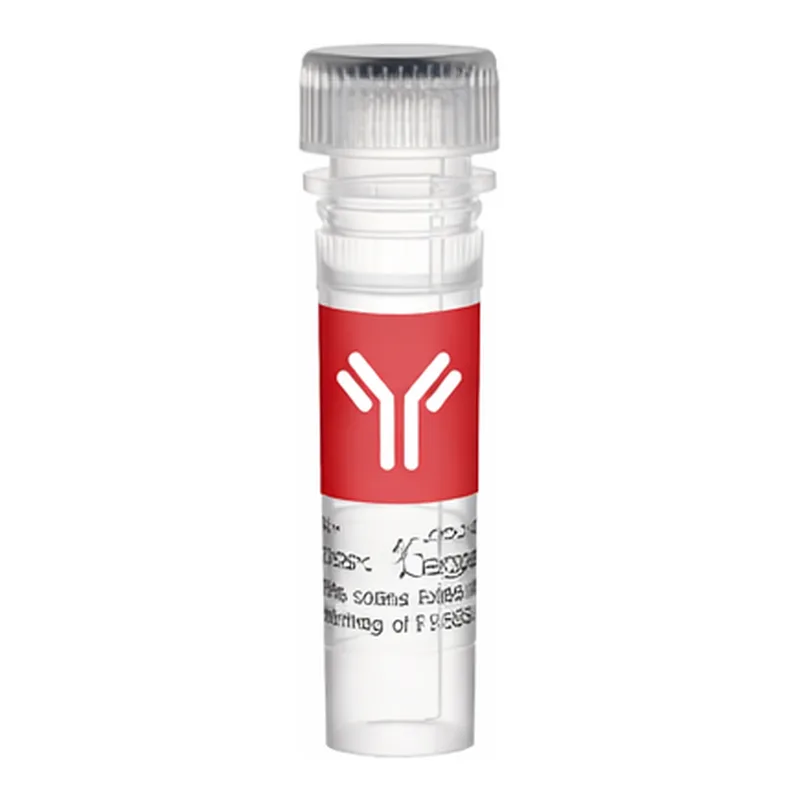
Thermo Fisher Scientific SUMO1 Polyclonal Antibody
SUMO1 단백질을 인식하는 Rabbit Polyclonal 항체로 Western blot, IHC, ICC/IF, Flow Cytometry에 적합합니다. Human 및 Rat 시료에 반응하며, Protein A 및 Antigen affinity chromatography로 정제되었습니다. 연구용으로만 사용 가능합니다.
- 판매단위
- pk
카탈로그
1개 옵션 · 카탈로그 번호를 클릭하면 복사됩니다Thermo Fisher Scientific · Thermo Fisher Scientific SUMO1 Polyclonal Antibody
Applications and Tested Dilutions
| Application | Tested Dilution |
|---|---|
| Western Blot (WB) | 1:1,000 |
| Immunohistochemistry (Paraffin) (IHC (P)) | 1:50–1:100 |
| Immunocytochemistry (ICC/IF) | 1:10–1:100 |
| Flow Cytometry (Flow) | 1:10–1:50 |
Product Specifications
| Specification | Description |
|---|---|
| Species Reactivity | Human, Rat |
| Host / Isotype | Rabbit / IgG |
| Class | Polyclonal |
| Type | Antibody |
| Immunogen | Human SUMO1 recombinant protein |
| Conjugate | Unconjugated |
| Form | Liquid |
| Concentration | 0.25 mg/mL |
| Purification | Protein A, Antigen affinity chromatography |
| Storage Buffer | PBS, pH 7.4 |
| Contains | 0.09% sodium azide |
| Storage Conditions | Store at 4°C short term. For long term storage, store at -20°C, avoiding freeze/thaw cycles. |
| Shipping Conditions | Ambient (domestic); Wet ice (international) |
| RRID | AB_2542060 |
Target Information
SUMO1 is an ubiquitin-like protein that can be covalently attached to proteins as a monomer or a lysine-linked polymer. Covalent attachment, via an isopeptide bond, to its substrates requires prior activation by the E1 complex SAE1-SAE2 and linkage to the E2 enzyme UBE2I, and can be promoted by E3 ligases such as PIAS1–4, RANBP2, or CBX4. This post-translational modification on lysine residues of proteins plays a crucial role in a number of cellular processes such as nuclear transport, DNA replication and repair, mitosis, and signal transduction. SUMO1 is involved, for instance, in targeting RANGAP1 to the nuclear pore complex protein RANBP2. Polymeric SUMO1 chains are also susceptible to polyubiquitination which functions as a signal for proteasomal degradation of modified proteins. SUMO1 may also regulate a network of genes involved in palate development. Mutations in the gene can result in non-syndromic orofacial cleft 10.
For Research Use Only. Not for use in diagnostic procedures. Not for resale without express authorization.
Thermo Fisher Scientific 상품 둘러보기
전체보기
문의
0개 · 배송·재고 문의는 실시간 상담이 빠릅니다아직 등록된 문의가 없어요.