

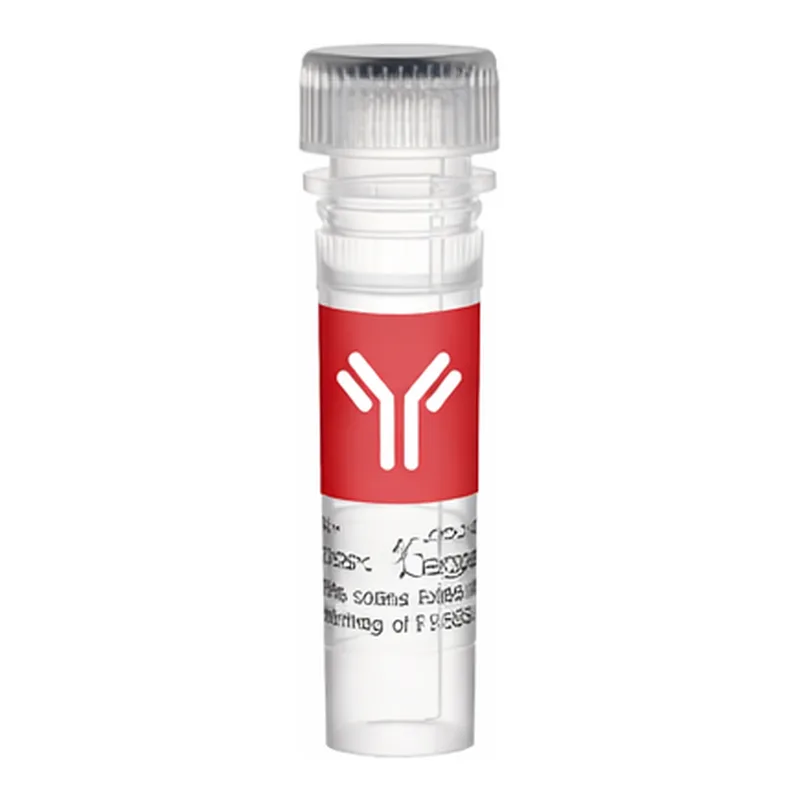
Thermo Fisher Scientific EPOR Monoclonal Antibody (OTI4F12), TrueMAB
인간 EPOR 단백질을 인식하는 마우스 단클론 항체로, WB 및 IHC(P)에서 검증됨. 무보존제, 동결건조 형태로 제공되며, 재구성 시 1 mg/mL 농도로 사용 가능. 적혈구 생성 관련 연구 및 신호전달 경로 분석에 적합.
- 판매단위
- pk
카탈로그
1개 옵션 · 카탈로그 번호를 클릭하면 복사됩니다Thermo Fisher Scientific · Thermo Fisher Scientific EPOR Monoclonal Antibody (OTI4F12), TrueMAB
Applications
Western Blot (WB)
- Tested Dilution: 1:2,000
Immunohistochemistry (Paraffin) (IHC (P))
- Tested Dilution: 1:150
Product Specifications
| 항목 | 내용 |
|---|---|
| Species Reactivity | Human |
| Host / Isotype | Mouse / IgG2a |
| Class | Monoclonal |
| Type | Antibody |
| Clone | OTI4F12 |
| Immunogen | Human recombinant protein fragment corresponding to amino acids 25–250 of human EPOR produced in E. coli |
| Conjugate | Unconjugated |
| Form | Lyophilized |
| Concentration | 1 mg/mL |
| Purification | Affinity chromatography |
| Storage Buffer | PBS, pH 7.3, with 8% trehalose |
| Contains | No preservative |
| Storage Conditions | -20°C, Avoid Freeze/Thaw Cycles |
| Shipping Conditions | Ambient (domestic); Wet ice (international) |
Product Specific Information
For reconstitution, add 100 µL distilled water to achieve a final antibody concentration of approximately 1 mg/mL.
For conjugation experiments, perform an additional desalting step using Zeba Spin Desalting Columns (7K MWCO, 0.5 mL, Product #89882).
Target Information
EpoR encodes the erythropoietin receptor, a member of the cytokine receptor family. Binding of erythropoietin activates Jak2 tyrosine kinase, leading to downstream signaling via Ras/MAP kinase, PI3K, and STAT transcription factors.
The activated receptor supports erythroid cell survival. Mutations or dysregulation may lead to erythroleukemia, familial erythrocytosis, or tumor growth abnormalities. Multiple transcript variants exist due to alternative splicing.
For Research Use Only. Not for use in diagnostic procedures. Not for resale without express authorization.
제품 이미지
Thermo Fisher Scientific 상품 둘러보기
전체보기
문의
0개 · 배송·재고 문의는 실시간 상담이 빠릅니다아직 등록된 문의가 없어요.