

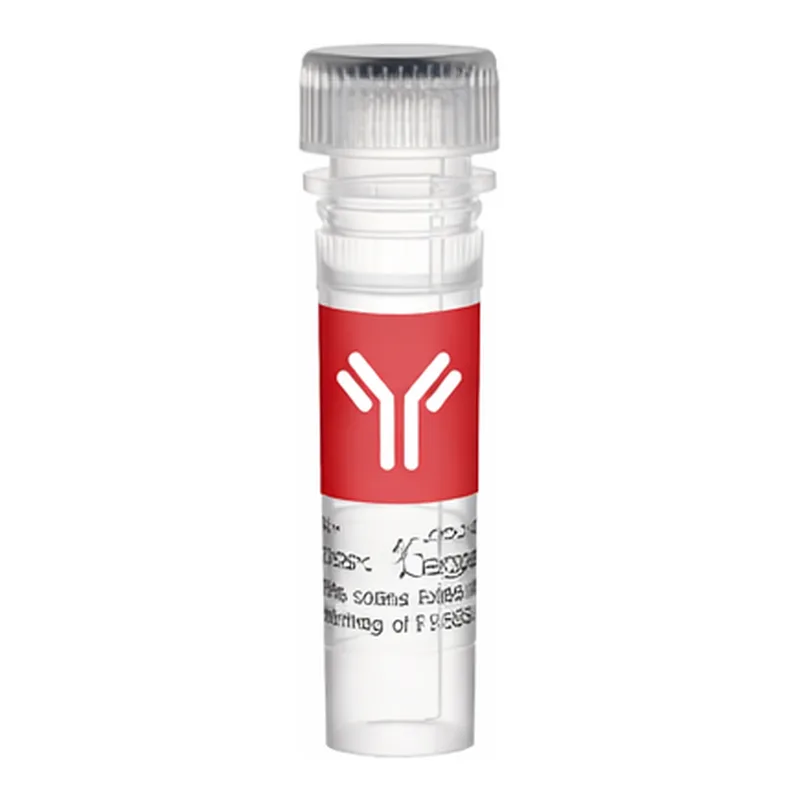
Thermo Fisher Scientific ADAR Monoclonal Antibody (GT1066)
ADAR1 단백질을 인식하는 Thermo Fisher Scientific의 GT1066 단클론 항체입니다. Western blot, ICC/IF, IP 등 다양한 응용에 적합하며, Human에 반응합니다. Protein G로 정제된 액상 형태로 제공되며 장기 보관 시 -20°C에서 안정적으로 유지됩니다.
- 판매단위
- pk
카탈로그
1개 옵션 · 카탈로그 번호를 클릭하면 복사됩니다Thermo Fisher Scientific · Thermo Fisher Scientific ADAR Monoclonal Antibody (GT1066)
Thermo Fisher Scientific ADAR Monoclonal Antibody (GT1066)
Applications and Tested Dilution
| Application | Tested Dilution | Publications |
|---|---|---|
| Western Blot (WB) | 1:500–1:3,000 | - |
| Immunocytochemistry (ICC/IF) | 1:100–1:1,000 | 1 publication |
| Immunoprecipitation (IP) | 1:100–1:500 | - |
Product Specifications
| 항목 | 내용 |
|---|---|
| Species Reactivity | Human |
| Published Species | Not Applicable |
| Host / Isotype | Mouse / IgG1 |
| Class | Monoclonal |
| Type | Antibody |
| Clone | GT1066 |
| Immunogen | Recombinant fragment containing amino acids 472–757 of ADAR1 |
| Conjugate | Unconjugated |
| Form | Liquid |
| Concentration | 1.0 mg/mL |
| Purification | Protein G |
| Storage Buffer | PBS, pH 7, with 20% glycerol |
| Contains | No preservative |
| Storage Conditions | Store at 4°C short term; for long term, store at -20°C avoiding freeze/thaw cycles |
| Shipping Conditions | Ambient (domestic); Wet ice (international) |
| RRID | AB_2538751 |
Product Specific Information
- Recommended positive controls: 293T, A431, HeLa, HepG2, A375
- Predicted reactivity: Mouse (80%), Rat (80%)
- Store as a concentrated solution; centrifuge briefly before opening the vial
Target Information
Adenosine Deaminase RNA Specific (ADAR) catalyzes the hydrolytic deamination of adenosine to inosine in double-stranded RNA (dsRNA), a process known as A-to-I RNA editing. This modification can alter gene expression and protein function through changes in:
- mRNA translation and codon usage
- Pre-mRNA splicing site recognition
- RNA stability and nuclease recognition
- RNA virus genome replication
- microRNA processing and protein-RNA interactions
ADAR edits both viral and cellular RNAs, either at multiple sites (hyper-editing) or specific sites (site-specific editing). Cellular substrates include BLCAP, GRIA2, HTR2C, and GABRA3, with site-specific editing leading to amino acid substitutions and altered protein functions.
Viral substrates include HCV, VSV, MV, HDV, and HIV-1. ADAR exhibits proviral or antiviral effects depending on the virus and editing mechanism. It impairs HCV replication via RNA editing, enhances MV, VSV, and HIV-1 replication through suppression of EIF2AK2/PKR activation, and promotes HIV-1 infectivity by editing adenosines in viral RNA regions. In HDV, ADAR mediates A-to-I editing converting an amber stop codon to tryptophan, enabling synthesis of large delta antigen (L-HDAg) essential for viral assembly. High ADAR1 levels, however, inhibit HDV replication.
(Source: Uniprot)
For Research Use Only. Not for use in diagnostic procedures. Not for resale without express authorization.
제품 이미지
(이미지 없음)
Thermo Fisher Scientific 상품 둘러보기
전체보기
문의
0개 · 배송·재고 문의는 실시간 상담이 빠릅니다아직 등록된 문의가 없어요.