

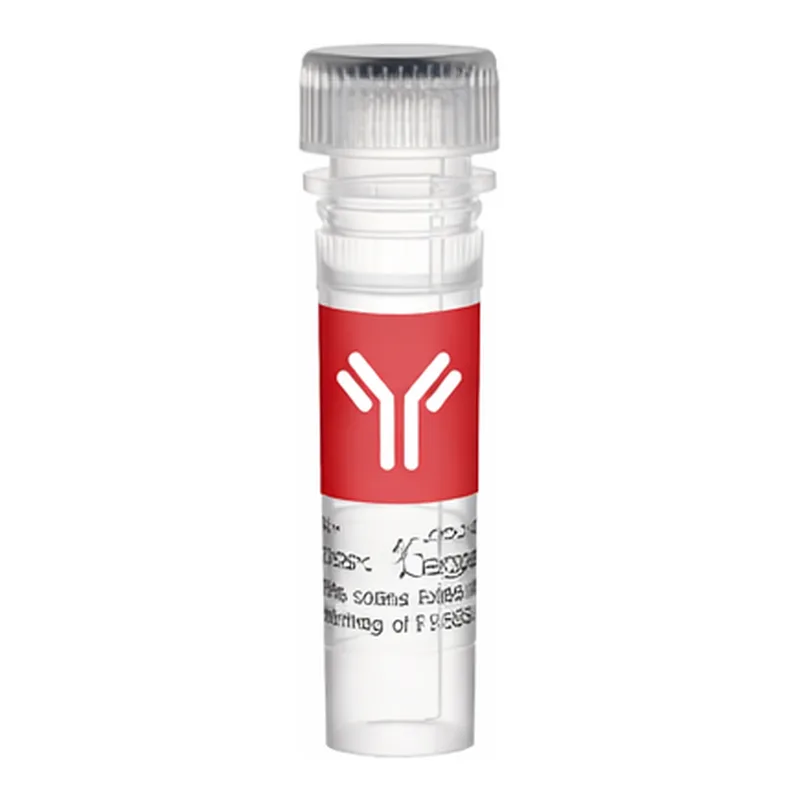
Thermo Fisher Scientific AROS Polyclonal Antibody
Human AROS 단백질을 인식하는 Rabbit Polyclonal Antibody로 Western blot 및 Immunoprecipitation에 적합합니다. 항원 친화 크로마토그래피로 정제되어 순도 95% 이상이며, PBS/glycerol buffer에 보존됩니다. 연구용으로만 사용 가능합니다.
- 판매단위
- pk
카탈로그
1개 옵션 · 카탈로그 번호를 클릭하면 복사됩니다Thermo Fisher Scientific · Thermo Fisher Scientific AROS Polyclonal Antibody
Thermo Fisher Scientific AROS Polyclonal Antibody
Applications and Tested Dilution
| Application | Tested Dilution |
|---|---|
| Western Blot (WB) | 1:500–1:1,000 |
| Immunoprecipitation (IP) | 1:50–1:200 |
Product Specifications
| 항목 | 내용 |
|---|---|
| Species Reactivity | Human |
| Host / Isotype | Rabbit / IgG |
| Class | Polyclonal |
| Type | Antibody |
| Immunogen | Synthetic peptide corresponding to residues in Human AROS |
| Conjugate | Unconjugated |
| Form | Liquid |
| Concentration | 1 mg/mL |
| Purification | Antigen affinity chromatography |
| Storage Buffer | PBS, pH 7.2, with 50% glycerol |
| Contains | 0.02% sodium azide |
| Storage Conditions | Store at 4°C short term. For long term storage, store at -20°C, avoiding freeze/thaw cycles. |
| Shipping Conditions | Wet ice |
| RRID | AB_2719589 |
Product Specific Information
The antibody was affinity-purified from rabbit antiserum by affinity chromatography using epitope-specific immunogen. The purity is >95% (by SDS-PAGE).
Target Information
AROS is a nucleolar protein of unknown function that interacts with extra ribosomal protein RPS19, playing a role in signaling pathways regulating rRNA transcription. The deduced amino acid sequence defines an isoelectric point of 11.3. No known functional motifs were found except a short polylysine tract embedded in a putative nucleolar localization signal. The protein is expressed ubiquitously with higher expression levels in certain tissues. Human AROS gene is mapped to chromosome 22q13.1.
For Research Use Only. Not for use in diagnostic procedures. Not for resale without express authorization.
Thermo Fisher Scientific 상품 둘러보기
전체보기
문의
0개 · 배송·재고 문의는 실시간 상담이 빠릅니다아직 등록된 문의가 없어요.