

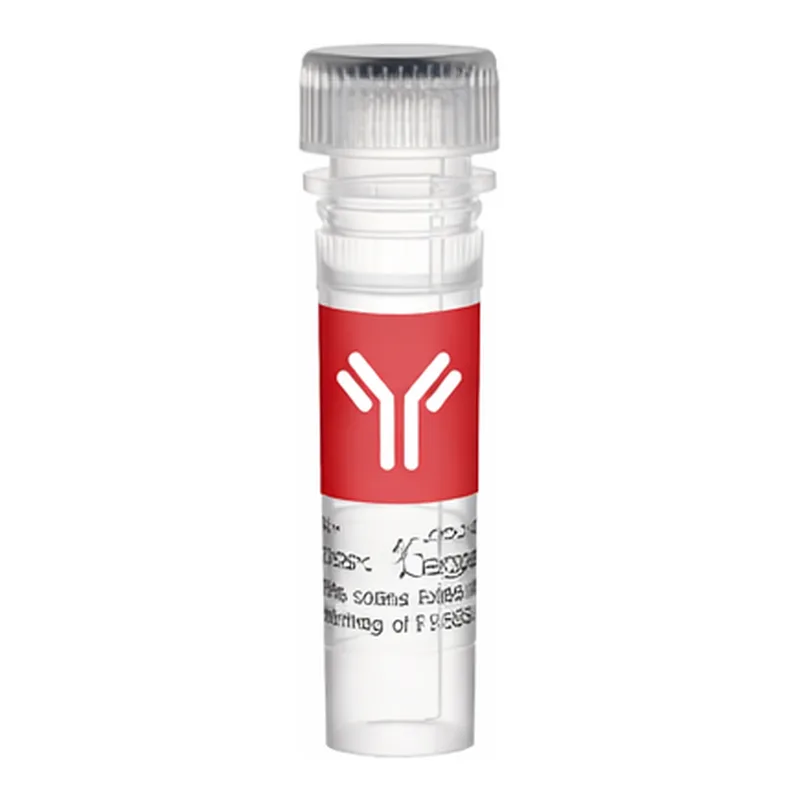
Thermo Fisher Scientific Smad1 + Smad5 Polyclonal Antibody
Smad1 및 Smad5 단백질을 인식하는 Thermo Fisher Scientific의 폴리클로날 항체로, IHC, ICC/IF, Flow Cytometry, ELISA 등 다양한 응용 가능. 사람 시료 반응성, Protein A 정제, 고농도(1 mg/mL) 액상 제품으로 연구용에 적합. -20°C 보관.
- 판매단위
- pk
카탈로그
1개 옵션 · 카탈로그 번호를 클릭하면 복사됩니다Thermo Fisher Scientific · Thermo Fisher Scientific Smad1 + Smad5 Polyclonal Antibody
Applications and Tested Dilution
| Application | Tested Dilution |
|---|---|
| Immunohistochemistry (Paraffin) (IHC (P)) | 1:200 |
| Immunohistochemistry (Frozen) (IHC (F)) | 1:100–1:500 |
| Immunocytochemistry (ICC/IF) | 1:100–1:500 |
| Flow Cytometry (Flow) | 1:20–1:100 |
| ELISA | 1:500–1:1,000 |
Product Specifications
| Specification | Description |
|---|---|
| Species Reactivity | Human |
| Host / Isotype | Rabbit / IgG |
| Class | Polyclonal |
| Type | Antibody |
| Immunogen | KLH conjugated synthetic peptide derived from human Smad5 |
| Conjugate | Unconjugated |
| Form | Liquid |
| Concentration | 1 mg/mL |
| Purification | Protein A |
| Storage Buffer | 0.01M TBS, pH 7.4, with 50% glycerol, 1% BSA |
| Contains | 0.02% ProClin 300 |
| Storage Conditions | -20°C |
| Shipping Conditions | Ambient (domestic); Wet ice (international) |
Target Information
The Smad family of proteins function in the transmission of extracellular signals in the TGF-beta signaling pathway. Binding of TGF-beta superfamily ligands to extracellular receptors triggers phosphorylation of Smad2 at a Serine-Serine-Methionine-Serine (SSMS) motif at its C-terminus. Phosphorylated Smad2 forms a complex with Smad4, which accumulates in the nucleus to regulate gene expression.
In mammals, eight Smad proteins have been identified. They are divided into three functional groups:
- Receptor-activated Smads (R-Smads): Smad1, Smad2, Smad3, Smad5, Smad8
- Common mediator Smads (Co-Smads): Smad4
- Inhibitory Smads (I-Smads): Smad6, Smad7
R-Smads are directly phosphorylated by activated type I receptors on their C-terminal Ser-Ser-X-Ser (SSXS) motif. Smad2 and Smad3 respond to TGF-beta and activin, while Smad1, Smad5, and Smad8 respond to BMP (Bone Morphogenetic Protein). This phosphorylation enables R-Smad binding to Smad4 and translocation to the nucleus, regulating TGF-beta target genes. Smad6 and Smad7 inhibit these interactions by binding to type I receptors or Smad4.
For Research Use Only. Not for use in diagnostic procedures. Not for resale without express authorization.
Thermo Fisher Scientific 상품 둘러보기
전체보기
문의
0개 · 배송·재고 문의는 실시간 상담이 빠릅니다아직 등록된 문의가 없어요.