

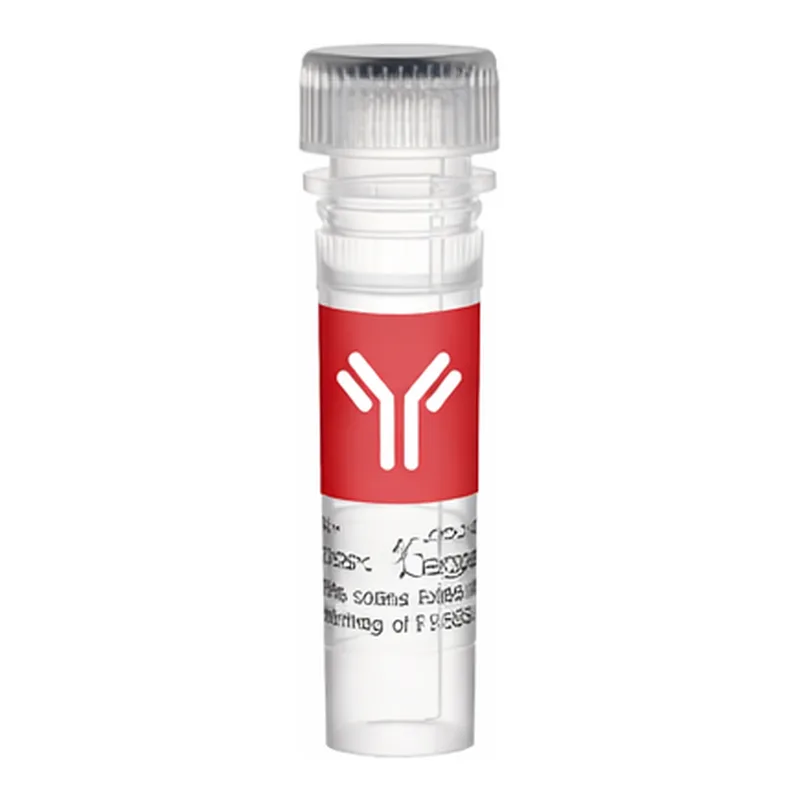
Thermo Fisher Scientific FGF2 Polyclonal Antibody
Rabbit polyclonal antibody recognizing human FGF2, validated for WB and IHC. Lyophilized form without preservative, reconstitutable in sterile water. Suitable for research on cell proliferation, angiogenesis, and tissue development. For research use only.
- 판매단위
- pk
카탈로그
1개 옵션 · 카탈로그 번호를 클릭하면 복사됩니다Thermo Fisher Scientific · Thermo Fisher Scientific FGF2 Polyclonal Antibody
Applications and Tested Dilutions
| Application | Tested Dilution | Publications |
|---|---|---|
| Western Blot (WB) | 1:300–1:2,000 | - |
| Immunohistochemistry (IHC) | 1:300–1:2,000 | - |
| Miscellaneous PubMed (Misc) | - | View 1 publication |
Product Specifications
| Item | Description |
|---|---|
| Species Reactivity | Human |
| Published Species | Not Applicable |
| Host / Isotype | Rabbit / Ig |
| Class | Polyclonal |
| Type | Antibody |
| Immunogen | A synthetic peptide from amino acid region 30–80 of human basic FGF conjugated to blue carrier protein |
| Conjugate | Unconjugated |
| Form | Lyophilized |
| Concentration | Not Determined |
| Storage Buffer | Whole serum |
| Contains | No preservative |
| Storage Conditions | Store at 4°C short term. For long term storage, store at -20°C, avoiding freeze/thaw cycles. Glycerol (1:1) may be added for added stability. |
| Shipping Conditions | Ambient (domestic); Wet ice (international) |
Product Specific Information
- Reconstitute in 150 µL of sterile water.
- Centrifuge to remove any insoluble material.
- Specificity: FGF2.
Target Information
FGF2 (also known as FGFb, fibroblast growth factor basic) belongs to the fibroblast growth factor (FGF) family and interacts with high-affinity transmembrane receptors to influence cell proliferation and tissue neovascularization.
FGF2 exists as five isoforms with distinct intracellular localizations and functions. The 18 kDa isoform is predominantly cytosolic and acts through cell surface receptors, whereas the 22, 22.5, 24, and 34 kDa isoforms are nuclear and may signal independent of transmembrane receptor pathways.
In humans, the gene is located on the q arm of chromosome 4. FGF2 is implicated in diverse biological processes such as limb and nervous system development, wound healing, and tumor growth.
The mRNA for FGF2 contains multiple polyadenylation sites and is alternatively translated from non-AUG and AUG initiation codons, resulting in five isoforms with distinct properties. The CUG-initiated isoforms are localized in the nucleus and are responsible for intracrine effects, whereas the AUG-initiated form is mostly cytosolic and mediates paracrine and autocrine effects.
Diseases associated with FGF2 dysfunction include Kaposi Sarcoma and corneal neovascularization.
For Research Use Only. Not for use in diagnostic procedures. Not for resale without express authorization.
Thermo Fisher Scientific 상품 둘러보기
전체보기
문의
0개 · 배송·재고 문의는 실시간 상담이 빠릅니다아직 등록된 문의가 없어요.