

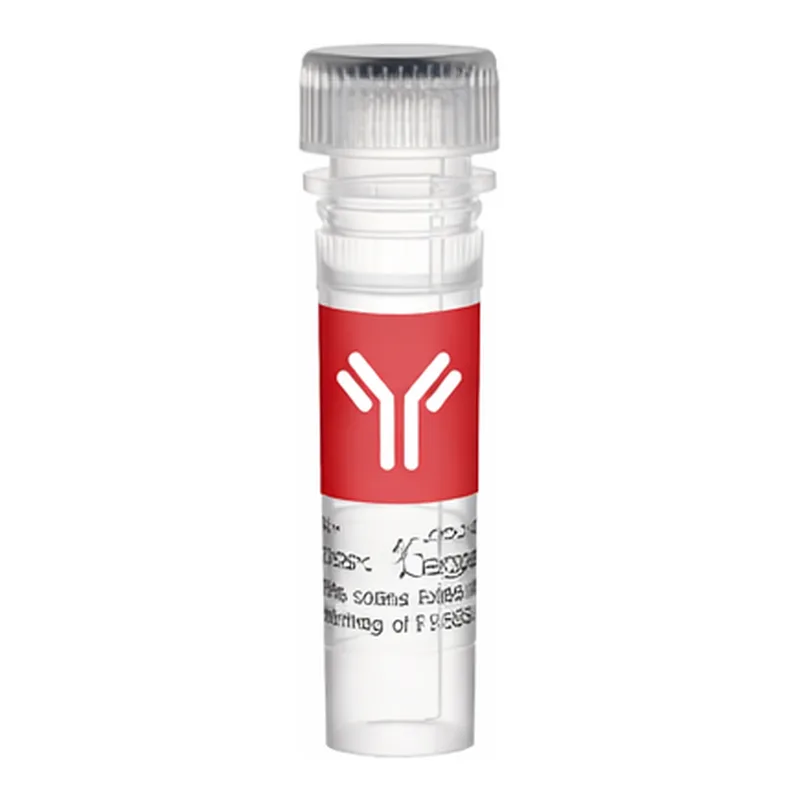
Thermo Fisher Scientific CRYBA1 Polyclonal Antibody
Human CRYBA1 단백질을 인식하는 Rabbit Polyclonal Antibody로 Western Blot에 적합. 합성 펩타이드(N-말단 aa 1–50)를 면역원으로 제작. 고순도 Affinity chromatography 정제, 액상 형태로 제공. 장기 보관 시 -20°C에서 소분 보관 권장.
- 판매단위
- pk
카탈로그
1개 옵션 · 카탈로그 번호를 클릭하면 복사됩니다Thermo Fisher Scientific · Thermo Fisher Scientific CRYBA1 Polyclonal Antibody
Applications
- Western Blot (WB): 0.2–1 µg/mL
Product Specifications
| 항목 | 내용 |
|---|---|
| Species Reactivity | Human |
| Host / Isotype | Rabbit / IgG |
| Class | Polyclonal |
| Type | Antibody |
| Immunogen | Synthetic peptide directed towards the N-terminal region of human CRYBA1 (aa 1–50) |
| Conjugate | Unconjugated |
| Form | Liquid |
| Concentration | 0.5 mg/mL |
| Purification | Affinity chromatography |
| Storage Buffer | PBS with 2% sucrose |
| Contains | 0.09% sodium azide |
| Storage Conditions | -20°C, Avoid Freeze/Thaw Cycles |
| Shipping Conditions | Wet ice |
| RRID | AB_2884475 |
Product Specific Information
- Immunogen sequence:
METQAEQQEL ETLPTTKMAQ TNPTPGSLGP WKITIYDQEN FQGKRMEFTS - Storage guidance:
For short-term use, store at 2–8°C up to 1 week. For long-term storage, store at -20°C in small aliquots to prevent freeze-thaw cycles. - Predicted homology:
Cow: 100% | Dog: 100% | Guinea Pig: 100% | Horse: 100% | Human: 100% | Mouse: 100% | Rabbit: 100% | Rat: 100% | Zebrafish: 86%
Target Information
Crystallins are separated into two classes: taxon-specific (enzyme) and ubiquitous. The ubiquitous class constitutes the major proteins of the vertebrate eye lens and maintains lens transparency and refractive index.
Lens fiber cells lose their nuclei during development; thus, crystallins are synthesized once and retained throughout life, making them extremely stable proteins.
Mammalian lens crystallins are divided into alpha, beta, and gamma families; beta and gamma crystallins form a superfamily.
Beta-crystallins, the most heterogeneous group, differ by the presence of a C-terminal extension (present in the basic group, absent in the acidic group).
Beta-crystallins form aggregates of various sizes and can self-associate or form heterodimers with other beta-crystallins.
The CRYBA1 gene encodes two proteins (crystallin beta A3 and beta A1) from a single mRNA; beta A1 is 17 amino acids shorter and produced via an alternate translation initiation site.
Deletion of exons 3 and 4 causes the autosomal dominant disease zonular cataract with sutural opacities.
For Research Use Only.
Not for use in diagnostic procedures.
Not for resale without express authorization.
제품 이미지
(이미지 없음)
Thermo Fisher Scientific 상품 둘러보기
전체보기
문의
0개 · 배송·재고 문의는 실시간 상담이 빠릅니다아직 등록된 문의가 없어요.