

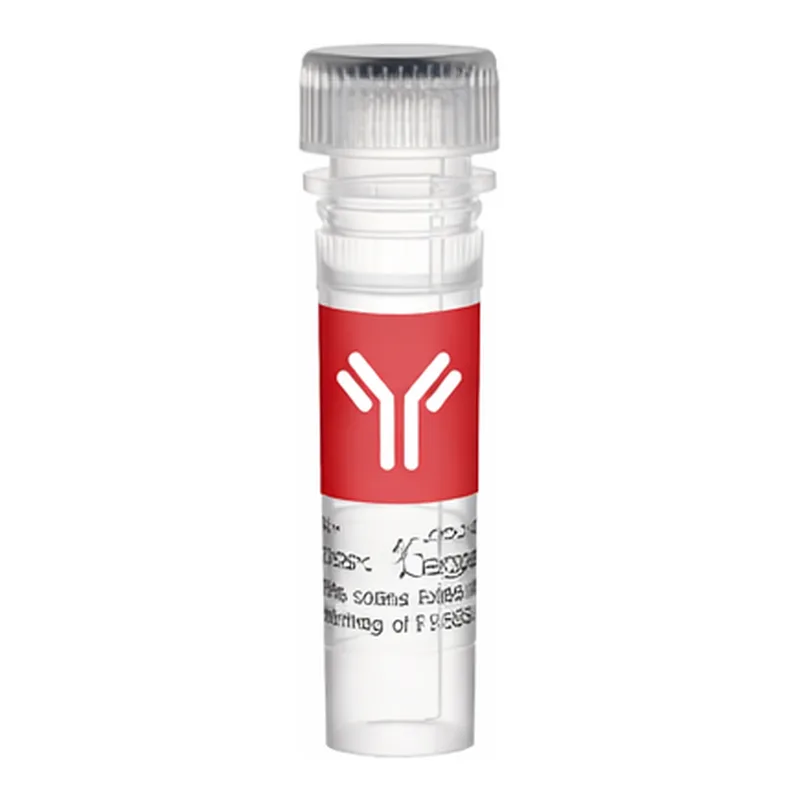
Thermo Fisher Scientific CD23 (Fc Epsilon RII) Monoclonal Antibody (FCER2/6892)
인간 CD23(Fc Epsilon RII)을 인식하는 Mouse monoclonal antibody. IHC(P) 및 IHC(PFA) 실험에 적합하며, 단백질 A/G로 정제된 액상 형태. 4°C 보관, 연구용으로만 사용 가능.
- 판매단위
- pk
카탈로그
2개 옵션 · 카탈로그 번호를 클릭하면 복사됩니다Thermo Fisher Scientific · Thermo Fisher Scientific CD23 (Fc Epsilon RII) Monoclonal Antibody (FCER2/6892)
Applications and Tested Dilutions
| Application | Tested Dilution |
|---|---|
| Immunohistochemistry (Paraffin) (IHC (P)) | 2 µg/mL |
| Immunohistochemistry (PFA fixed) (IHC (PFA)) | 1–2 µg/mL |
Product Specifications
| 항목 | 내용 |
|---|---|
| Species Reactivity | Human |
| Host / Isotype | Mouse / IgG2b, kappa |
| Class | Monoclonal |
| Type | Antibody |
| Clone | FCER2/6892 |
| Immunogen | Recombinant fragment (around aa 200–300) of human FCER2/CD23 protein |
| Conjugate | Unconjugated |
| Form | Liquid |
| Concentration | 200 µg/mL |
| Purification | Protein A/G |
| Storage Buffer | PBS, pH 7.4, with 0.05% BSA |
| Contains | 0.05% sodium azide |
| Storage Conditions | 4°C, do not freeze |
| Shipping Conditions | Ambient (domestic); Wet ice (international) |
Target Information
CD23 is a 45 kDa glycoprotein present on a subpopulation of freshly isolated peripheral blood and tonsil B cells and is strongly expressed on EBV-transformed B lymphoblasts. The CD23 molecule is identical to the low-affinity IgE receptor found on B cells. Expression of CD23 has been detected in neoplastic cells from cases of B cell chronic lymphocytic leukemia and some cases of centroblastic/centrocytic lymphoma. Functionally, CD23 is involved in B cell growth and differentiation, and IgE production. It also has a soluble form that acts as a potent mitogenic factor. Diseases associated with CD23 dysfunction include chronic conjunctivitis and chronic lymphocytic leukemia.
For Research Use Only. Not for use in diagnostic procedures. Not for resale without express authorization.
Thermo Fisher Scientific 상품 둘러보기
전체보기
문의
0개 · 배송·재고 문의는 실시간 상담이 빠릅니다아직 등록된 문의가 없어요.