

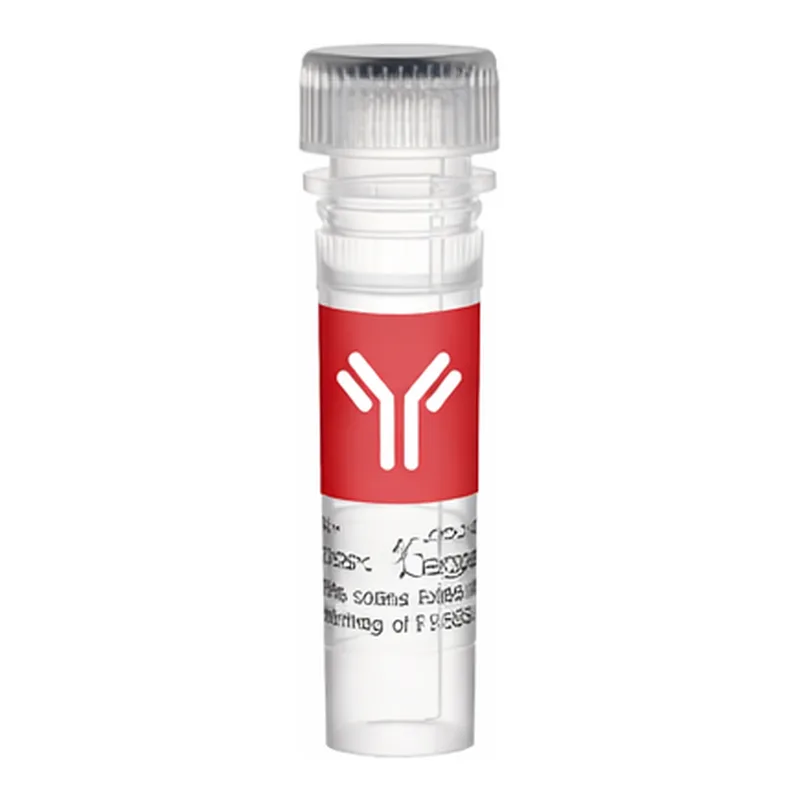
Thermo Fisher Scientific MXI1 Polyclonal Antibody
MXI1 단백질을 인식하는 Rabbit Polyclonal 항체로, Western blot 및 IHC에 적합합니다. Human과 Mouse에 반응하며, 합성 펩타이드로부터 제작되었습니다. 고순도 친화 크로마토그래피 정제, 0.5 mg/mL 농도, PBS buffer에 보관됩니다.
- 판매단위
- pk
카탈로그
1개 옵션 · 카탈로그 번호를 클릭하면 복사됩니다Thermo Fisher Scientific · Thermo Fisher Scientific MXI1 Polyclonal Antibody
Applications and Tested Dilution
| Application | Tested Dilution |
|---|---|
| Western Blot (WB) | 1.0 µg/mL |
| Immunohistochemistry (IHC) | 1:200 |
| Immunohistochemistry (Paraffin) (IHC (P)) | Assay-Dependent |
Product Specifications
| 항목 | 내용 |
|---|---|
| Species Reactivity | Human, Mouse |
| Host / Isotype | Rabbit / IgG |
| Class | Polyclonal |
| Type | Antibody |
| Immunogen | Synthetic peptide directed towards the N-terminal region of mouse MXI1 |
| Conjugate | Unconjugated |
| Form | Liquid |
| Concentration | 0.5 mg/mL |
| Purification | Affinity chromatography |
| Storage Buffer | PBS with 2% sucrose |
| Contains | 0.09% sodium azide |
| Storage Conditions | -20°C, Avoid Freeze/Thaw Cycles |
| Shipping Conditions | Wet ice |
| RRID | AB_2689489 |
Product Specific Information
This target displays homology in the following species:
Cow: 100%; Dog: 100%; Guinea Pig: 93%; Horse: 93%; Human: 86%; Mouse: 100%; Pig: 100%; Rat: 100%
Target Information
It is well established that Myc regulation of cell proliferation and differentiation involves a family of related transcription factors. One such factor, Max, is an obligate heterodimeric partner for Myc and can also form heterodimers with at least four related proteins designated Mad 1, Mxi1, Mad 3 and Mad 4.
Like Mad 1 and Mxi1, association of Mad 3 and Mad 4 with Max results in transcriptional repression. Both Myc and the Mad proteins have short half-lives and their synthesis is tightly regulated, while Max expression is constitutive and relatively stable.
Two related mammalian cDNAs have been identified and shown to encode Mad-binding proteins. Both possess sequence homology with the yeast transcription repressor Sin3 including four conserved paired amphipathic helix (PAH) domains.
mSin3A and mSin3B specifically interact with the Mad proteins via their second paired amphipathic helix domain (PAH2). It has been suggested that Mad-Max heterodimers repress transcription by tethering mSin3 to DNA as corepressors.
For Research Use Only. Not for use in diagnostic procedures. Not for resale without express authorization.
Thermo Fisher Scientific 상품 둘러보기
전체보기
문의
0개 · 배송·재고 문의는 실시간 상담이 빠릅니다아직 등록된 문의가 없어요.