

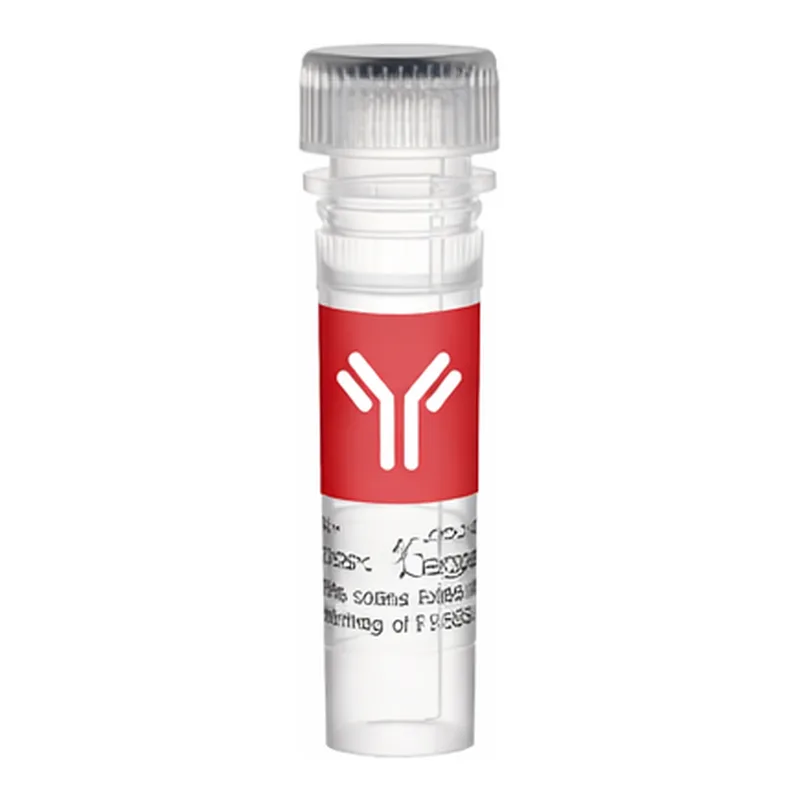
Thermo Fisher Scientific USP13 Polyclonal Antibody
Rabbit polyclonal antibody against Human USP13 for WB and IP applications. Recognizes deubiquitinase involved in autophagy and ERAD pathways. Purified via antigen affinity chromatography and Protein A. Supplied in PBS with ProClin 300, stored at -20°C.
- 판매단위
- pk
카탈로그
1개 옵션 · 카탈로그 번호를 클릭하면 복사됩니다Thermo Fisher Scientific · Thermo Fisher Scientific USP13 Polyclonal Antibody
Thermo Fisher Scientific USP13 Polyclonal Antibody
Applications and Tested Dilution
| Application | Tested Dilution |
|---|---|
| Western Blot (WB) | 1:500–1:2,000 |
| Immunoprecipitation (IP) | 1–5 µL/mg of lysate |
Product Specifications
| Specification | Description |
|---|---|
| Species Reactivity | Human |
| Host / Isotype | Rabbit / IgG |
| Class | Polyclonal |
| Type | Antibody |
| Immunogen | E. coli-derived Human USP13 fragment |
| Conjugate | Unconjugated |
| Form | Liquid |
| Purification | Antigen affinity chromatography, Protein A |
| Storage Buffer | PBS, pH 7 |
| Contains | 0.03% ProClin 300 |
| Storage Conditions | -20°C, Avoid Freeze/Thaw Cycles |
| Shipping Conditions | Wet ice |
| RRID | AB_2902937 |
Target Information
Deubiquitinase that mediates deubiquitination of target proteins such as BECN1, MITF, SKP2, and USP10, involved in processes like autophagy and endoplasmic reticulum-associated degradation (ERAD).
Component of a regulatory loop controlling autophagy and p53/TP53 levels: stabilizes PIK3C3/VPS34-containing complexes by deubiquitinating BECN1, a key autophagy regulator. Also deubiquitinates USP10, an essential regulator of p53/TP53 stability.
PIK3C3/VPS34-containing complexes, in turn, regulate USP13 stability, suggesting a feedback system managing p53/TP53 protein levels via USP10 and USP13.
Recruited by nuclear UFD1, USP13 mediates deubiquitination of SKP2, regulating ERAD. It also acts on UBL4A, a component of the BAG6/BAT3 complex.
USP13 stabilizes SIAH2 independently of deubiquitinase activity by binding ubiquitinated SIAH2 and inhibiting its autoubiquitination.
Shows weak deubiquitinase activity in vitro, preferentially cleaving Lys-63-linked polyubiquitin chains. Unlike USP5, it does not disassemble unanchored polyubiquitin.
Can cleave ISG15 in vitro, though further validation is required. [UniProt]
Usage Notes
For Research Use Only. Not for use in diagnostic procedures. Not for resale without express authorization.
Thermo Fisher Scientific 상품 둘러보기
전체보기
문의
0개 · 배송·재고 문의는 실시간 상담이 빠릅니다아직 등록된 문의가 없어요.