

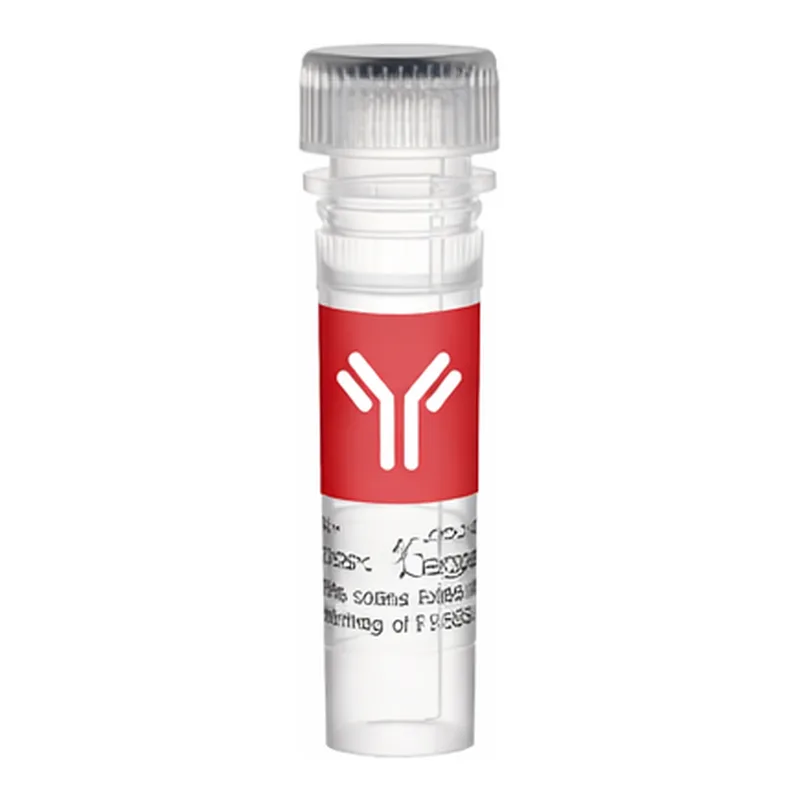
Thermo Fisher Scientific DLG4 Polyclonal Antibody, MaxPab
DLG4(PSD-95) 단백질을 타깃으로 하는 Thermo Fisher Scientific의 토끼 폴리클로날 항체. 인간 시료에 반응하며 Western blot에 적합. 액상 형태로 제공되며 PBS(pH 7.4) 버퍼에 보존제 없이 저장. 연구용으로만 사용 가능.
- 판매단위
- pk
카탈로그
1개 옵션 · 카탈로그 번호를 클릭하면 복사됩니다Thermo Fisher Scientific · Thermo Fisher Scientific DLG4 Polyclonal Antibody, MaxPab
Thermo Fisher Scientific DLG4 Polyclonal Antibody, MaxPab
Applications
- Western Blot (WB)
Tested Dilution: 1–5 µg/mL
Product Specifications
| 항목 | 내용 |
|---|---|
| Species Reactivity | Human |
| Host / Isotype | Rabbit / IgG |
| Class | Polyclonal |
| Type | Antibody |
| Immunogen | DLG4 (NP_001356.1, 1–767 a.a) full-length human protein |
| Conjugate | Unconjugated |
| Form | Liquid |
| Concentration | See Label |
| Purification | Affinity chromatography |
| Storage Buffer | PBS, pH 7.4 |
| Contains | No preservative |
| Storage Conditions | -20°C, Avoid Freeze/Thaw Cycles |
| Shipping Conditions | Ambient (domestic); Wet ice (international) |
Product Specific Information
Sequence of this protein is as follows:
MSQRPRAPRS ALWLLAPPLL RWAPPLLTVL HSDLFQALLD ILDYYEASLS ESQKYRYQDE DTPPLEHSPA HLPNQANSPP VIVNTDTLEA PGYELQVNGT EGEMEYEEIT LERGNSGLGF SIAGGTDNPH IGDDPSIFIT KIIPGGAAAQ DGRLRVNDSI LFVNEVDVRE VTHSAAVEAL KEAGSIVRLY VMRRKPPAEK VMEIKLIKGP KGLGFSIAGG VGNQHIPGDN SIYVTKIIEG GAAHKDGRLQ IGDKILAVNS VGLEDVMHED AVAALKNTYD VVYLKVAKPS NAYLSDSYAP PDITTSYSQH LDNEISHSSY LGTDYPTAMT PTSPRRYSPV AKDLLGEEDI PREPRRIVIH RGSTGLGFNI VGGEDGEGIF ISFILAGGPA DLSGELRKGD QILSVNGVDL RNASHEQAAI ALKNAGQTVT IIAQYKPEEY SRFEAKIHDL REQLMNSSLG SGTASLRSNP KRGFYIRALF DYDKTKDCGF LSQALSFRFG DVLHVIDASD EEWWQARRVH SDSETDDIGF IPSKRRVERR EWSRLKAKDW GSSSGSQGRE DSVLSYETVT QMEVHYARPI IILGPTKDRA NDDLLSEFPD KFGSCVPHTT RPKREYEIDG RDYHFVSSRE KMEKDIQAHK FIEAGQYNSH LYGTSVQSVR EVAEQGKHCI LDVSANAVRR LQAAHLHPIA IFIRPRSLEN VLEINKRITE EQARKAFDRA TKLEQEFTEC FSAIVEGDSF EEIYHKVKRV IEDLSGPYIW VPARERL
Target Information
Post Synaptic Density 95 kDa (PSD-95), also known as synapse-associated protein 90 kDa (SAP90), is one of a family of membrane-associated proteins found in the postsynaptic density in forebrain neurons and certain presynaptic structures in the cerebellum.
Like other members of the family, PSD-95 has three 90 amino acid repeats called PDZ domains followed by an SH3 domain and a yeast guanylate kinase homology (GuK) domain.
PSD-95 is believed to participate in the clustering of certain proteins, including NMDA receptors and Shaker-type potassium channels at the synaptic membrane in CNS neurons.
There are two principal modes of interaction between PSD-95 and other proteins:
- NMDA receptors and Shaker-type potassium channels share a C-terminal sequence homology with a threonine/serine-X-valine-COOH (T/SXV) motif.
- Other neuronal proteins that share this motif (β1 adrenergic receptor, some serotonin receptors, sodium channel subunits, and additional potassium channel subunits) may interact with PSD-95 via its PDZ domains.
Neuronal nitric oxide synthase (nNOS), which lacks the T/SXV motif but has its own PDZ domain, can associate with PSD-95 through a pseudo-homotypic PDZ-PDZ interaction.
For Research Use Only. Not for use in diagnostic procedures. Not for resale without express authorization.
Thermo Fisher Scientific 상품 둘러보기
전체보기
문의
0개 · 배송·재고 문의는 실시간 상담이 빠릅니다아직 등록된 문의가 없어요.