

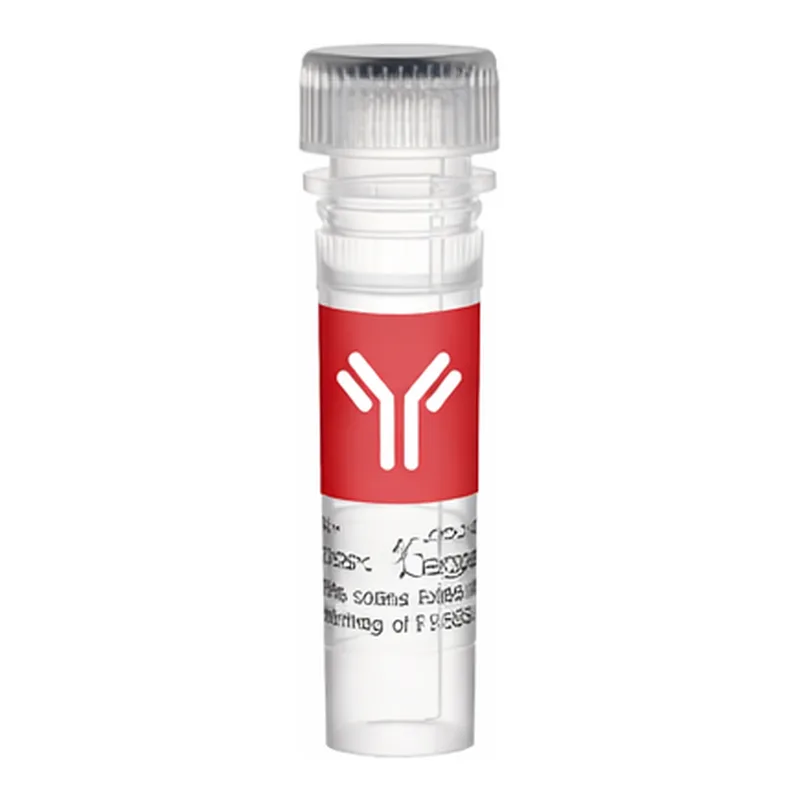
Thermo Fisher Scientific USP15 Polyclonal Antibody
USP15 단백질을 인식하는 Rabbit Polyclonal Antibody로, Human 및 Mouse 시료에 반응합니다. Western blot과 Immunoprecipitation에 적합하며, 항원 친화 크로마토그래피로 정제되었습니다. 액상 형태로 1 mg/mL 농도이며, 4°C에서 보관합니다.
- 판매단위
- pk
카탈로그
1개 옵션 · 카탈로그 번호를 클릭하면 복사됩니다Thermo Fisher Scientific · Thermo Fisher Scientific USP15 Polyclonal Antibody
Applications
Western Blot (WB)
- Tested Dilution: 1:2,000–1:10,000
Immunoprecipitation (IP)
- Tested Dilution: 2–10 µg/mg lysate
Product Specifications
| 항목 | 내용 |
|---|---|
| Species Reactivity | Human, Mouse |
| Host/Isotype | Rabbit / IgG |
| Class | Polyclonal |
| Type | Antibody |
| Immunogen | Region between residue 960 and the C-terminus of Human Ubiquitin Specific Peptidase 15 |
| Conjugate | Unconjugated |
| Form | Liquid |
| Concentration | 1 mg/mL |
| Purification | Antigen affinity chromatography |
| Storage Buffer | Tris citrate/phosphate, pH 7–8 |
| Contains | 0.09% sodium azide |
| Storage Conditions | 4°C |
| Shipping Conditions | Wet ice |
Product Specific Information
- Recommended shelf life: 1 year from date of receipt
- Application Note: For IHC, epitope retrieval with Tris-EDTA pH 9.0 is recommended for FFPE tissue sections.
- Based on 100% sequence identity, this antibody is predicted to react with X. tropicalis and Bovine.
Target Information
Modification of target proteins by ubiquitin participates in a wide array of biological functions. Proteins destined for degradation or processing via the 26S proteasome are coupled to multiple copies of ubiquitin. Attachment of ubiquitin or ubiquitin-related molecules may also result in changes in subcellular distribution or modification of protein activity.
Deubiquitination is catalyzed by proteases called deubiquitinating enzymes (DUBs), which fall into four distinct families:
- Ubiquitin C-terminal hydrolases
- Ubiquitin-specific processing proteases (USPs)
- OTU-domain ubiquitin-aldehyde-binding proteins
- Jab1/Pad1/MPN-domain-containing metallo-enzymes
Among these, USPs are the most widespread and conserved across evolution. They tend to release ubiquitin from conjugated proteins and possess conserved catalytic domains containing Cys and His boxes, with variable N- or C-terminal extensions that contribute to substrate recognition, localization, and interactions.
For Research Use Only. Not for use in diagnostic procedures. Not for resale without express authorization.
Thermo Fisher Scientific 상품 둘러보기
전체보기
문의
0개 · 배송·재고 문의는 실시간 상담이 빠릅니다아직 등록된 문의가 없어요.