

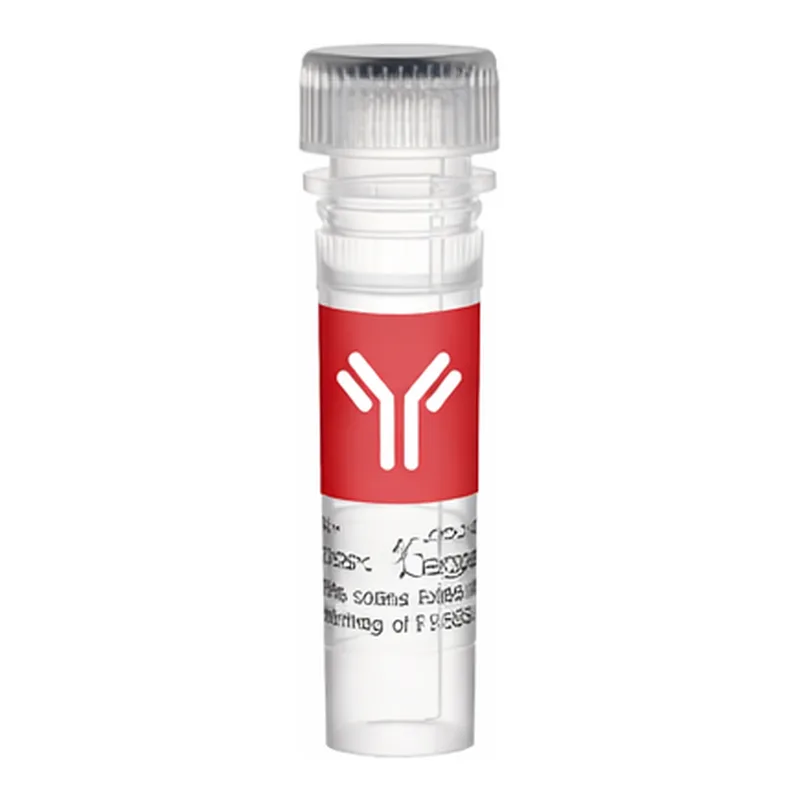
Thermo Fisher Scientific CD19 Recombinant Rabbit Monoclonal Antibody (ZR212), RAbMono
CD19 단백질 검출용 재조합 토끼 단클론 항체로, IHC(P) 분석에 적합합니다. 인간 시료에 반응하며, CHO 세포에서 발현된 IgG 형식의 항체입니다. 단백질 A로 정제되었으며, 4°C에서 보관합니다. 연구용으로만 사용 가능합니다.
- 판매단위
- pk
카탈로그
2개 옵션 · 카탈로그 번호를 클릭하면 복사됩니다Thermo Fisher Scientific · Thermo Fisher Scientific CD19 Recombinant Rabbit Monoclonal Antibody (ZR212), RAbMono
Applications
- Immunohistochemistry (Paraffin) (IHC (P)): 1:100–1:200
Product Specifications
| 항목 | 내용 |
|---|---|
| Species Reactivity | Human |
| Host / Isotype | Rabbit / IgG |
| Expression System | CHO cells |
| Class | Recombinant Monoclonal |
| Type | Antibody |
| Clone | ZR212 |
| Immunogen | Recombinant fragment of human CD19 protein (around aa 96–281) |
| Conjugate | Unconjugated |
| Form | Liquid |
| Concentration | 200 µg/mL |
| Purification | Protein A |
| Storage Buffer | Tris with BSA, NP-40 |
| Contains | <0.1% sodium azide |
| Storage Conditions | 4°C |
| Shipping Conditions | Wet ice |
Product Specific Information
A recommended positive control tissue for this product is Lymph Node, however positive controls are not limited to this tissue type.
The primary antibody is intended for laboratory professional use in the detection of the corresponding protein in formalin-fixed, paraffin-embedded tissue stained in manual qualitative immunohistochemistry (IHC) testing. This antibody is intended to be used after the primary diagnosis of tumor has been made by conventional histopathology using non-immunological histochemical stains.
In normal lymphoid tissue, CD19 is observed in germinal centers (on both B cells and follicular dendritic cells), in mantle zone cells and in scattered cells in the interfollicular areas, with an overall immunoreactivity pattern similar to that of CD20 and CD22. However, in contrast to CD20, CD19 is also expressed in pre-B cells. CD19 positivity is seen in the vast majority of B-cell neoplasms (B-lymphoblastic lymphoma, small lymphocytic lymphoma/CLL, mantle cell lymphoma, follicular lymphoma, Burkitt lymphoma, marginal zone lymphoma, diffuse large B-cell lymphoma, T-cell-rich B-cell lymphoma, lymphoblastic lymphoma, hairy cell leukemia) and commonly at a lower intensity than normal B-cell elements. Plasma cell neoplasms are consistently negative as are T-cell neoplasms. CD19 was undetectable in some diffuse large B-cell lymphomas, T-cell-rich B-cell lymphomas, and post-transplant B-lymphoproliferative diseases. CD19 expression is not seen in Reed Sternberg cells of classic Hodgkin lymphoma.
Antibody is used with formalin-fixed and paraffin-embedded sections. Pretreatment of deparaffinized tissue with heat-induced epitope retrieval or enzymatic retrieval is recommended.
In general, immunohistochemical (IHC) staining techniques allow for the visualization of antigens via the sequential application of a specific antibody to the antigen (primary antibody), a secondary antibody to the primary antibody (link antibody), an enzyme complex, and a chromogenic substrate with interposed washing steps. The enzymatic activation of the chromogen results in a visible reaction product at the antigen site. Results are interpreted using a light microscope and aid in the differential diagnosis of pathophysiological processes.
A positive tissue control must be run with every staining procedure performed. This tissue may contain both positive and negative staining cells or tissue components and serve as both the positive and negative control tissue.
External positive control materials should be fresh autopsy/biopsy/surgical specimens fixed, processed, and embedded as soon as possible in the same manner as the patient samples.
Tissues used for the external positive control materials should be selected from specimens with well-characterized low levels of the positive target activity that give weak positive staining to ensure detection of subtle changes in antibody sensitivity or staining methodology.
Internal or external negative control tissue may be used depending on organizational guidelines. The variety of cell types present in many tissue sections offers internal negative control sites. Components that do not stain should demonstrate the absence of specific staining and indicate non-specific background staining. If specific staining occurs in the negative control sites, results with the patient specimens must be considered invalid.
Target Information
CD19 is a member of the immunoglobulin superfamily and has two Ig-like domains. The CD19 molecule is expressed on 100% of peripheral B cells as defined by expression of kappa or lambda light chains.
CD19 appears to be expressed on myeloid leukemia cells, particularly those of monocytic lineage. It is the earliest and broadest B cell–restricted antigen and a key regulator of normal and malignant B cell proliferation.
CD19 functions as a signal-amplifying coreceptor for the B cell receptor (BCR) and can also signal independently. Mutation of the CD19 gene results in hypogammaglobulinemia, whereas overexpression causes B cell hyperactivity.
For Research Use Only. Not for use in diagnostic procedures. Not for resale without express authorization.
Thermo Fisher Scientific 상품 둘러보기
전체보기
문의
0개 · 배송·재고 문의는 실시간 상담이 빠릅니다아직 등록된 문의가 없어요.