

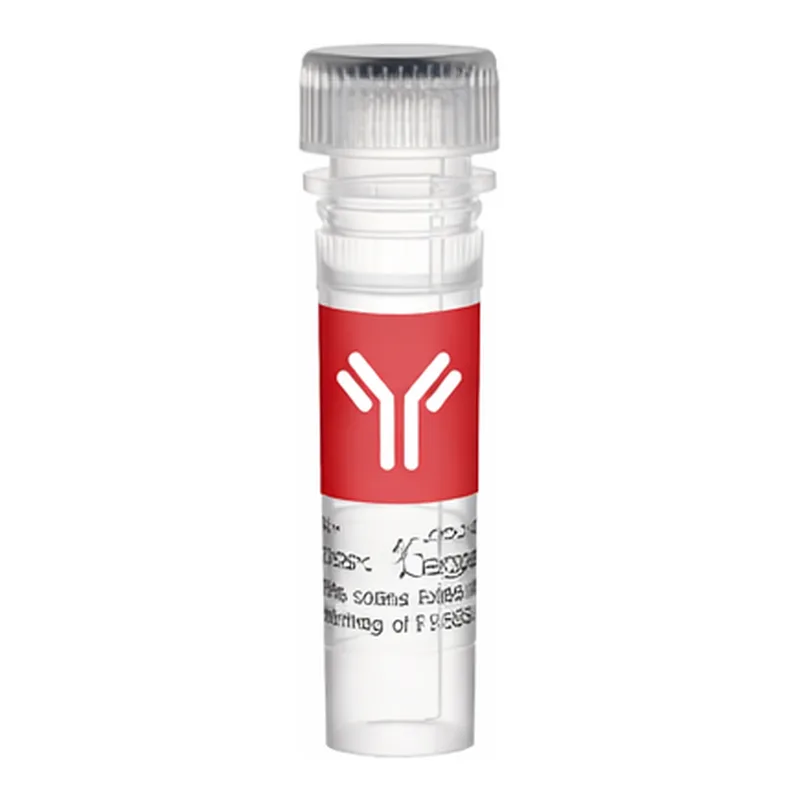
Thermo Fisher Scientific SMYD5 Polyclonal Antibody
Human SMYD5 단백질을 인식하는 Thermo Fisher Scientific의 Rabbit Polyclonal Antibody로, WB 및 IHC(P) 실험에 적합합니다. 항원 친화 크로마토그래피로 정제되었으며, 액상 형태로 제공되어 높은 특이성과 안정성을 보장합니다.
- 판매단위
- pk
카탈로그
1개 옵션 · 카탈로그 번호를 클릭하면 복사됩니다Thermo Fisher Scientific · Thermo Fisher Scientific SMYD5 Polyclonal Antibody
Applications
Western Blot (WB)
Immunohistochemistry (Paraffin) (IHC (P))
Product Specifications
| 항목 | 내용 |
|---|---|
| Species Reactivity | Human |
| Host / Isotype | Rabbit / IgG |
| Class | Polyclonal |
| Type | Antibody |
| Immunogen | Recombinant protein corresponding to Human SMYD5. Recombinant protein control fragment (Product #RP-103042). |
| Conjugate | Unconjugated |
| Form | Liquid |
| Concentration | 0.05 mg/mL |
| Purification | Antigen affinity chromatography |
| Storage Buffer | PBS, pH 7.2, with 40% glycerol |
| Contains | 0.02% sodium azide |
| Storage Conditions | Store at 4°C short term. For long term, store at -20°C, avoiding freeze/thaw cycles. |
| Shipping Conditions | Wet ice |
| RRID | AB_2647668 |
Product Specific Information
Immunogen sequence:
MYCSAECRLA ATEQYHQVLC PGPSQDDPLH PLNKLQEAWR SIHYPPETAS IMLMARMVAT VKQAKDKDRW IRLFSQFCNK TANEEEEIVH KLLGDKFKG
Highest antigen sequence identity to orthologs:
- Mouse: 82%
- Rat: 91%
Target Information
Retinoic acid (RA) represents the oxidized form of vitamin A and, via interactions with retinoic acid receptors (RARs), plays a crucial role in development, cellular growth, and differentiation.
The gene encoding RAI15 maps to human chromosome 2, which houses over 1,400 genes and comprises nearly 8% of the human genome.
Harlequin ichthyosis, a rare and morbid skin deformity, is associated with mutations in the ABCA12 gene, while the lipid metabolic disorder sitosterolemia is associated with defects in the ABCG5 and ABCG8 genes.
Additionally, an extremely rare recessive genetic disorder, Alström syndrome, is caused by mutations in the ALMS1 gene, which maps to chromosome 2.
For Research Use Only. Not for use in diagnostic procedures. Not for resale without express authorization.
Thermo Fisher Scientific 상품 둘러보기
전체보기
문의
0개 · 배송·재고 문의는 실시간 상담이 빠릅니다아직 등록된 문의가 없어요.