

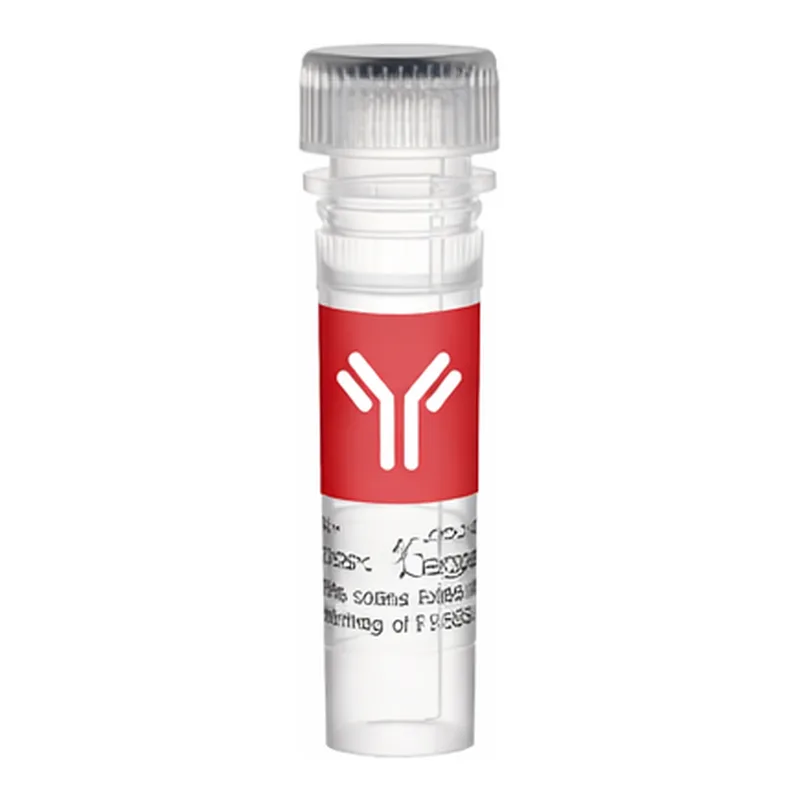
Thermo Fisher Scientific UBE2E3 Monoclonal Antibody (OTI4G4), TrueMAB
Thermo Fisher Scientific의 UBE2E3 Monoclonal Antibody (OTI4G4)는 인간 및 생쥐 시료에서 UBE2E3 단백질 검출용으로 최적화된 TrueMAB 제품입니다. Western blot과 유세포분석에 적합하며, 고순도 액상 형태로 안정적인 신호를 제공합니다. 연구용으로만 사용 가능합니다.
- 카탈로그번호
- TA504683
- 판매단위
- pk
카탈로그
1개 옵션 · 카탈로그 번호를 클릭하면 복사됩니다Thermo Fisher Scientific · Thermo Fisher Scientific UBE2E3 Monoclonal Antibody (OTI4G4), TrueMAB
Applications
- Western Blot (WB): 1:500–1:2,000
- Flow Cytometry (Flow): 1:100
Product Specifications
| 항목 | 내용 |
|---|---|
| Species Reactivity | Human, Mouse |
| Host / Isotype | Mouse / IgG2b |
| Class | Monoclonal |
| Type | Antibody |
| Clone | OTI4G4 |
| Immunogen | Full length human recombinant protein of human UBE2E3 produced in E. coli |
| Conjugate | Unconjugated |
| Form | Liquid |
| Concentration | 0.7 mg/mL |
| Purification | Affinity chromatography |
| Storage Buffer | PBS with 1% BSA, 50% glycerol |
| Contains | 0.02% sodium azide |
| Storage Conditions | -20°C, Avoid Freeze/Thaw Cycles |
| Shipping Conditions | Ambient (domestic); Wet ice (international) |
Target Information
The ubiquitin (Ub) pathway involves three sequential enzymatic steps that facilitate the conjugation of Ub and Ub-like molecules to specific protein substrates.
- E1 enzyme activates the Ub C-terminus using ATP.
- E2 enzyme (UBE2E3) conjugates Ub to form the Ub-E2 intermediate complex.
- E3 ligase transfers Ub from E2 to the target protein substrate.
UBE2E3, also known as UBCH9, catalyzes the covalent attachment of ubiquitin to other proteins and plays a role in regulating transepithelial sodium transport in renal cells. It may also be involved in cell growth arrest. The protein shuttles between the cytoplasm and nucleus in an IPO11-dependent manner and is expressed ubiquitously at low levels, with high expression in skeletal muscle.
For Research Use Only. Not for use in diagnostic procedures. Not for resale without express authorization.
Thermo Fisher Scientific 상품 둘러보기
전체보기
문의
0개 · 배송·재고 문의는 실시간 상담이 빠릅니다아직 등록된 문의가 없어요.